
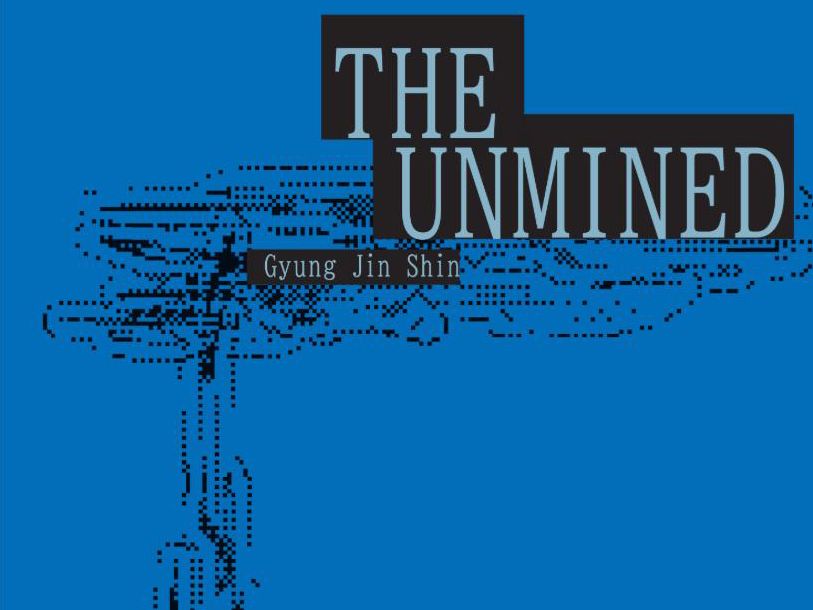
Whereas artificial intelligence (AI) has reshaped our vernacular and infiltrated our quotidian landscape with various forms of handy consumer technology, there is a vast blank space artists could fill in: what are the intricacies of the computational processes of data we call Machine Learning (ML), what are the learning models and what exactly do they do? Artists should be familiar with contemporary art’s growing emphasis on processes and concepts of an open work over just the final product: what differences would they make in the case of ML, whose main usage has been for predicting outcomes? Assuming that the materiality of ML qualifies it for a new kind of artistic medium and raw material, what are the implications on artmaking in contemporary times? Between the technology experts and scholars in the humanities, artists have unique roles to play. They could do more than humanities scholars’ caution against euphemism for new technology. They could also do more than propagating packaged software and, by doing that, reinforcing the black-box phenomenon in our relationship with technology. Gyung-jin Shin’s recent solo The Unmined (2025.09.13-10.11) tactically occupies the junction of some of the questions outlined above, and particularly on how ML has been used to generate social knowledge, and how art may play a role in magnifying the hidden mechanisms, suggesting why the “black box” must be opened a little more even if the mathematics behind are too alien to the everyday citizen. She raises her questions via visualization, through an assemblage of what Walter Benjamin will call perceptual differential mediums. [1] Subsequently, her exhibition space displays clusters of sculptural installation, diagrammatization as networked maps of textual units on walls, and video exposé, all sitting together, without partition, to form an open dialogue that is at once conspicuous and enigmatic.
Loss of humanness, or knowledge asymmetry?
Even “emotions” are datafied and calculated. This is one thought driving the project.
Looking around, this thought echoes everywhere as we find ourselves surrounded by endless recent technological offerings. They are designed by tech films to detect our emotions through encoding and decoding the text we use as well as our facial expressions deploying facial recognition in CGI research. Subsequently, we find FaceBook’s propagation of “emotional contagion” aiming to affect our emotional behavior, Apple’s face coding Emotient (2016), Microsoft’s “cognitive services” and IBM’s Watson which reads emotions, Amazon’s Alexa voice-activated assistant for listening for signs of emotions and more. [2] As AI infiltrates the folds and crevices of our everyday life, Emotion AI software increasingly advances into real-time on-device processing, taking into account, as claimed, privacy and a integrated analysis with facial expression, voice and text examined all at once. A 2025 novelty, Facial Action Coding System (FACS) even claims to detect specific muscle movements of facial expressions, i.e. the fine nuances of human emotional states. [3] Hume AI (2025) is one example of “emphatic AI”; Noldus is a face reader used in academic and professional research, Kairos detects age, gender and focuses on ethical AI development, and the list goes on.
Even “emotions” are datafied and calculated. This is the trigger for Shin’s project. We may call it a kind of “reification” after György Lukács, a phenomenon he problematized back in the 1970s. “Reification” is dehumanization by turning humans into quantified values, the result of which is to turn complex social relations be4tween human individuals and institutions into fixed, objective thing-like entities. [4] Lukács’ critical object is capitalism. Today, our contexts have new composite labels and yet-to-be articulated mechanisms: oligarchy, i.e. a prevalent merge of media, politics and economics, total control via surveillance appearing to be media democracy, mixed with neo-liberal euphemisms of a world of free access and open opportunities. Is Lukács irrelevant to contemporary society half of a century after his writing? Against this context, in The Unmined, which is a critique of loss of humanness, Shin plays up abstraction and objectification head-on as her overall strategy.
ML by definition reduces things of the world, including human emotions and personality, to numerical forms managed as logistics and computable resources. The social science samples Shin quotes demonstrate of how the use of ML transforms on-going research in psychology: emotions can be coded for classification and clustering, and regrouped infinitely into combinatorial composite accounts for human profiling; on top of that, numerical statistics are replaced by natural language descriptors resulting from coded-decoded texts in the database. The case in question is far more than the problem of human-thing binary: other than ratifying or reifying humanism, Shin seeks to understand a different kind of “live-ness” we still own, and what vitality we may derive from making such effort. ML is both deductive and inductive: it starts with very specific data to study and for the machine to learn, and yet the learning process, rather than being restricted by precepts, extracts data fragments derived from traces of living and human behaviour. ML facilitates recognition in Boolean events, as well, it looks into the unknown to predict and project, based on large enough data samples from our daily life, as if what the machine makes sense of all comes from us, or at least it appears so.
The Unmined is an attempt to narrowing the gaps that need to be closed between having AI running our everyday life and our state of proletarianization [5], i.e. lack of knowledge and loss of knowledge by design as we get increasingly engrossed in technological labour and consumerism. Shin’s strategy is to activate the visitor; she encourages curious, inquisitive visitors who are willing to wander through the labyrinth she sets up. Writing as inscription forms and sculptural abstraction are isolated and yet juxtaposed, resulting in a modernist note of reflexivity and alienation to augment visitors’ attentiveness.
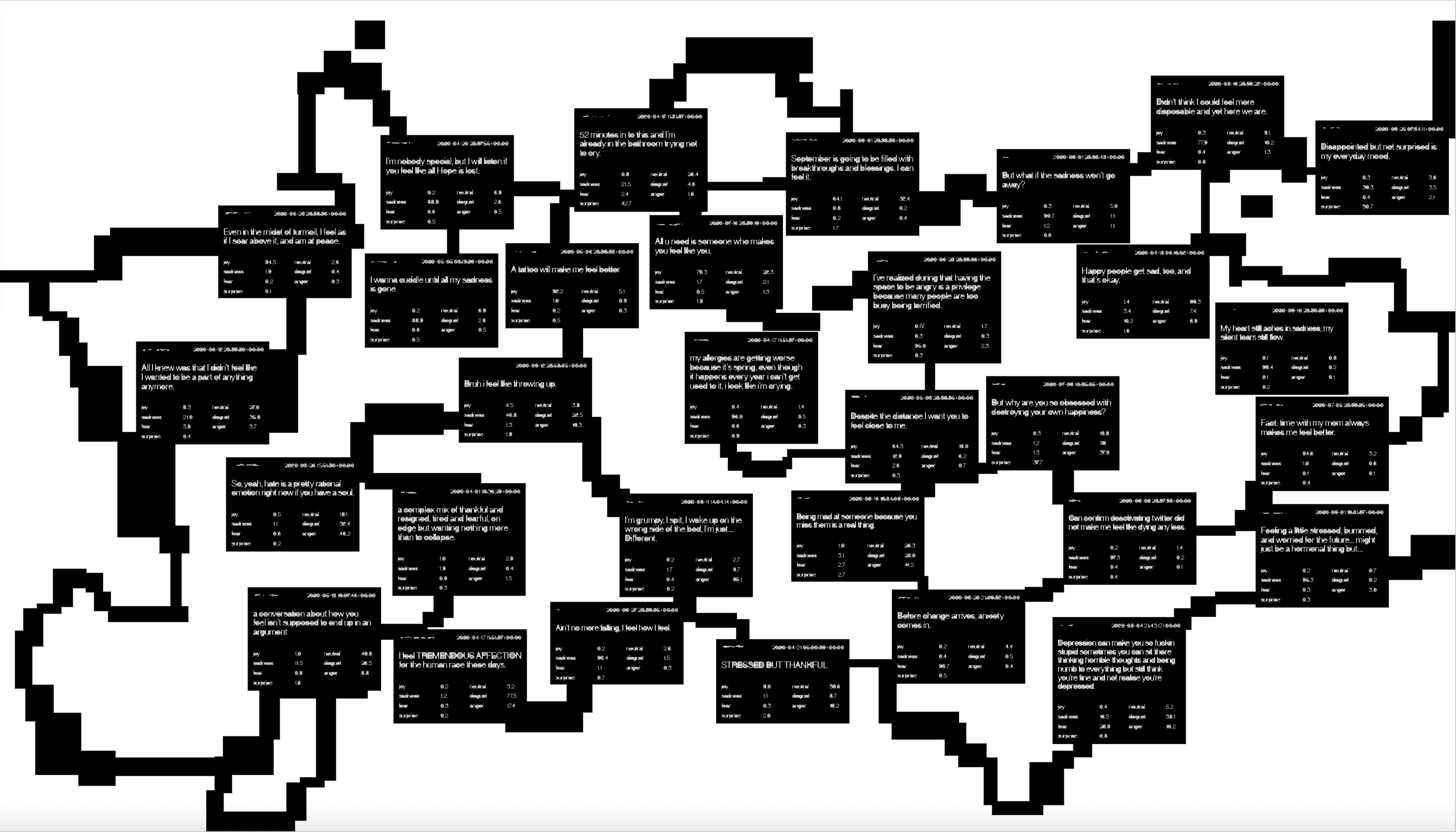
Shin’s assemblage of varied technical apparatuses asserts the juxtaposition of perceptual differential mediums, each of which affords a unique intellectual-affective dimension of her exposé. Her approach asserts that the world, especially that afforded by AI-ML, must be experienced in complex, multiple and dynamic ways. Each artistic medium addresses a different level of our consciousness. The wall map, though speaking to our intellect with comprehensible natural language, presents a lot of gaps as the texts are grouped and boxed in with enigmatic connectivity. The sculptural pieces address us sensuously, and yet uphold “empty spaces” in which a visitor could freely dwell. The video is narrative -- at once dramatic, expository, poetic and annotative. Are the video on screen a side note, or is it simply background information?
From data as form to data as enigma
Without giving up the critical examination of “emotions” being datafied and learned through calculation, Shin seeks tide-turning potential through an art event. She takes up concrete instances of sentiment analysis to visualize them. The black sculptural objects are far from tailormade homogenous products – each has its own shape, organic and not geometric, by which data of concrete living are abstracted, for pondering with her show-not-tell approach.
Shin’s spatial strategy suggests equal weight given to each of the varied creative mediums, asserting organological implications, i.e. the psychic, biological and technological cannot be separated. [6] Thus, private emotions are linked to broader ramifications: not only are private emotions the disciplinary object of psychology’s use of ML, but also AI’s growing reliance on certain precious minerals has serious long-term implications on labour and the environment. In the long run, Bernard Stiegler’s understanding of technical organs is relevant here: technologies aren't just external aids but are constitutive of our being, acting as external memory systems (like writing or digital archives) that allow experience to transcend the biological body. Stiegler also upholds a pharmacological view, arguing that technologies are both heal and harm as they alter our attention and induce societal crises. The question throws back on to that of how we live.The Unmined covers a broad transdisciplinary trajectory, from symbolic packaging of emotions of a taxonomy of facial expression to computed abstracted representation, to AI-related labor, and to mineral, the most basic material form of our digital culture. To her list, I would add annual statistics of the escalating demand for energy and clean water as strategic data centers grow in number, usually owned by just a handful of tech giants. The story of private emotions is linked to the story of oligarchical presence.
Gyung-jin Shin’s exhibition may not have made issues described above lucid and explicit, and yet it hits the right spot by presenting itself as a spatial and perceptual enigma: it is a valid a test-case (and also showcase) of data as both knowledge communication and artistic raw material; it is a test case of what questions must be asked now and for future. The show is full of meaningful ellipses, anchoring us right on the spot. Without any use of fanciful or high-end machines, the show sets us off pondering on our AI/ML-configured world which we have taken for granted. Indeed, in our data-driven and datafied society in general, living, working, private emotions, leisure, learning, spiritual welfare governing, marketing, physical health, education and more are inseparable and treated on the same algorithmic horizon. Shin’s artistic treatment also echoes with my anticipation of a new phase in media art: we have entered a machine-less phase of media art as whatever material we use, from text, sculpture, news feeds, search engines, images and sounds and more, a lot of it could have been generated by a knowledge system afforded and reconfigured by AI-ML. A recent solo show by this writer’s – [?] and Crevices of the Everyday (2025.10.18-11.21) – was a self-conscious attempt to minimize heavy machines to make a statement on data-driven media-artmaking. In a foreseeable new milieu of media art, heavy machines have given way to handy digital devices and media content turned constantly shifting via cloud-based networked connectivity. “Data” is the axiom: data is visible, and yet data generates new spectacles. If the elevator-lift is the classical example of a machine with black-boxed, or hidden, operational procedures, our datafied society in the AI milieu is a gigantic black box.
We have always existed as data: the materiality of data containers
Historically, AI could exist, and have existed, without ML through older methods. Symbolic AI, for example, is a kind of knowledge-based systems: they are rule-based, using hardcodes rules and logic to make decisions; they rely on vast amounts of explicitly programmed knowledge to reason and solve problems. An example would be programming a robot to play chess through pre-defined strategies and logic gates. Symbolic AI as such relies on explicit human-readable rules and logic; with given precepts it operates as a white box, with its decision processes traceable. This top-down approach is reverted in ML, which could be described as bottom-up adaptive learning, whereby statistical methods are deployed to learn patterns from data. It is in this sense that ML, especially in deep learning, is like a “black box” as it is basically impossible to explain how a decision or an output is reached. Whereas Symbolic AI can work with little data, ML often uses large datasets, and here is where questions on where data are mined and who forms and owns the dataset become critical issues of concern.
From a media archaeological perspective, humans have always existed as data, from the early government administrations of the Sumerians (3500 BCE, Mesopotamia), such as individual labourer’s beer-rationing record, to the earliest use of photographs to file individual prisoner in Shanghai in the late 19th century, to the perfection of filing system for better retrieval via computation at war times, and cybernetics applied in contemporary society to achieve total discipline and control. All this precedes micro surveillance through our ownership of digital devices, as well as facial recognition and emotion tracking we now consider.
The key question is: how much are we aware of the “data” aspect of things human and banal-quotidian? Everything and anything could be data, the questions to ask could be:
When is a number a piece of data?
When does an object not just an object, but data?
When does an image (or a piece of sound) become data?
Fact is: computation is at work in every folds and crevices of our daily routine.
Data start as records, or notated records. An image, for example, could be just an artifact of impression, a memento, the material signification of something or just a record. But when an image is considered a piece of data, it implies a process of breaking down an image and its semantic and material construct for generative possibilities. Data understand objects as units, which anticipates complexity when subject to computation. Data range from fundamental numerical structures to specialized, high-performance storage systems designed for massive datasets assembly. The notion of data must be considered alongside data structure. Data structure is about how data is organized in memory for processing; it works with storage containers which stores and manages data in pipelines.
Data containers: where the question of aesthetics surmounts
There are different kinds of data container. A common example we all know is the file in a filing system. Jaron Lanier comments:
“Our conception of files may be more persistent than our ideas about nature. I can imagine that someday physicists might tell us that it is time to stop believing in photons, because they have discovered a better way to think about light — but the file will likely live on.” [8]
Commenting on how we should manage, store, and monetize data for the benefit of all, Lanier calls attention for “data-dignity,” addressed not only to the everyday person, but especially artists. To him, databases are presented to us as “ready-mades,” offering ready-made-commentaries on contemporary life. He warns that artists who work with databases should be concerned with the aesthetic, the rationale, and the politics of data organization, retrieval, and navigation.
Data containers exist in many common forms. In 1960, with Project Xanadu, Ted Nelson anticipated a new type of data container by creating the concept for a hypertext environment. With this new data container, all data can be virtually re-used through available lists of desired contents anyone creates, linked bi-directionally. As each piece of content has a unique address, it is totally possible to obtain the original context of a piece of information. By contrast, data containers in modern ML is about amassment, concealing the discrete identity of a piece of information.
As for the social life of data, back in 1945, Vannevar Bush’s essay “As We May Think” proposes his vision of a “collective memory machine”: concerned with the sciences’ destructive tendency in development, he explains how a collective memory machine may promote understanding instead, highlighting the potential to make knowledge more accessible for all. [9] Is accessibility the issue in the age of ML? Should we, rather, worry about knowledge asymmetries? [10]
In the history of data and data structure, data is an object, which could be a number, a physical object, a physical file, computer file which is analogous to the filing system in a clerical setting. In the digital era, data is a point in space, it could be expressed as (x,y), to point cloud usage, expressing a point as having (x,y,z) values, thus affording transmediality, allowing shifts across a variety of media and different systems of knowledge. AI data structure combines storage, organization and retrieval into a complex operation. Just for the sake of everyday AI literacy, some terms have entered our daily conversations: for example, a key data structure is the graph with multiple nodal relationships connected by edges for pathfinding. The vocabulary of AI data structure also includes trees, queues, linked lists and stacks, and multi-dimensional arrays called tensors.
It is in this context that I may start asking very different questions, assuming new criteria to understand what Shin has organized on site for the visitors. The group sculptures are like data containers without disclosing (revealing?) the data structure and storage containers she picks up from a specific psychological research. From a different perspective, she is not hiding them, but simply indicating their presence and isolating them into constrastive perceptual objects. The text templates on the wall are indicative of specific contents (emotions) in clustering, and that fact that they have a computable relation with clustered emotions in other textual templates. The Unmined is Shin’s materialist contemplation. Numerical data (in the form of statistical tables) are reverted to figurative-abstract sculptural objects: one could walk around and among them, without the push for definite denotation. Gaps between display objects are spaces for curious questioning, refuting definitive interpretation, which is the diametrical opposite of ML’s discriminatory operation. Shin’s display is unfolding, refolding and unfolding, non-hierarchically cross-disciplinary. Varied media objects are placed on the same plane to be examined for their potential mutability. She calls for an artistic access that is at once synchronizing and reflexive. In doing this, she has turned database into a performative writing space, pointing to the dynamic operability of her data, open to reconfiguration.
What is a piece of data? Under what conditions does an object become data? A dataset is a collection of objects waiting to be processed to generate potential information. Data could be anything, from measurements, facts, images, texts, symbols to pieces of sound and more. Something becomes data when it is collected, prepared and trimmed to be transformed or rearranged, for instance classified and grouped with other objects. An essential quality of data is its openness to reconfiguration. There are two critical questions when something is regarded as a piece of data. First, where does the data come from, who are the collectors and what are the conditions of collecting? Second, what are the rules of processing, juxtaposition, organization and use? As data, an object is valued for its openness in establishing new relations with other objects, potentially giving rise to discursive meanings. Think of the sculptures, wall texts, connectivity maps and video not just as artistic mediums but as different datasets and data containers. What new correlations and intra-actions would we see? What reciprocal connectivity and generative serialization? How many different ways could they be combined to generate new meanings? What are the different ways to classify or group them? What kind of new knowledge does the show produce through juxtaposition? What research questions does juxtaposition trigger -- similarities and variability?
END OF PART 1
/30 January 2026
[1] See Walter Benjamin’s discussion in section III of “The Work of Art in the Age of Mechanical Reproduction” (1935, trans. Hannah Arendt); A similar discussion could be read in A Short History of Photography (1931)..
[2] Sergey Nivens (2017) “Tech firms want to detect your emotions and expressions, but people don’t like it.” Conversation, 27 June 2017. https://theconversation.com/tech-firms-want-to-detect-your-emotions-and-expressions-but-people-dont-like-it-80153
[3] Bryn Farnsworth (2025). “Facial Action Coding System (FACS) – A Visual Guidebook,” iMotions. https://imotions.com/blog/learning/research-fundamentals/facial-action-coding-system/?srsltid=AfmBOoq1xk7IUUFza4wVWb1Y5J27nH2fZB0v08GGlD1g8kAsabbBgV71
[4] Lukács, Georg. (1971). "Reification and the Consciousness of the Proletariat," in History and Class Consciousness: Studies in Marxist Dialectics; trans. Rodney Livingstone. Cambridge, MA: MIT Press. (Original work published 1923).
[5] Bernard Stiegler (2017), “The Proletarianization of Sensibility”; Boundary 2, February, 5-18, available: https://icamiami-org.storage.googleapis.com/2017/06/1fb92937-essay4-stiegler.pdf. See also: “Bernard Stiegler: Proletarianization by Technology…”; Homo HortusRead on 30 January 2026: https://homohortus31.wordpress.com/2025/10/01/bernard-stiegler-proletarianization-by-technology-or-the-loss-of-knowledge-in-the-industrial-and-digital-age/
[6] Bernard Stiegler 2020, “Elements for a General Organology,” Derrida Today issue 1, Volume: 13, 72–94. Read on 20 January 2026:
https://www.academia.edu/43027437/Bernard_Stiegler_Elements_for_a_General_Organology_2020_
[7] See section 3 in Linda Chiu-han Lai’s artist’s conceptual narrative for a site-specific solo show, “Folds, Wrinkles and Crevices of the Everyday” (18 Oct 2025-22 Nov 2026, Hong Kong). Exhibition proceedings. Essay in pdf uploaded December 2026: https://www.academia.edu/145051496/Folds_Wrinkles_and_Crevices_of_the_Everyday_Artists_conceptual_narrative_for_a_site_specific_solo_show_?sm=b
[8] Jaron Lanier, “Jaron Lanier Fixes the Internet,” Opinion, New York Times, 23 September, 2019. https://www.nytimes.com/interactive/2019/09/23/opinion/data-privacy-jaron-lanier.html
[9] Vannevar Bush, “As We May Think”; The Atlantic (July 1945), 112-124: https://worrydream.com/refs/Bush%20-%20As%20We%20May%20Think%20(Life%20Magazine%209-10-1945).pdf
[10] Linda Chiu-han Lai, Hector Rodriguez and the Writing Machine Collective addressed the issue with a symposium they organized, titled “Knowledge Asymmetries in the Age of Machine Learning,” featuring international scholars speaking on topics such as “Governing through Immunity: Techniques and Politics of COVID-19 Management” (Btihaj Ajana), “The Incommensurability between Human and Algorithmic Thought” (Beatrice Fazi), “Trustworthy Machine Learning” (Adrian Weller), “Playing with (or Being Played by) the Black Box: the Subjective Experience of Self-Presentation for Algorithmic Audiences” (Frank Pasquale) and more. Full documentation of the talk is available on the WMC website: https://www.writingmachine-collective.net/