

Originally an invited contribution by HKIFF, the piece is Linda Lai's renewed understanding of Godfrey Reggio's "The Qasi Trilogy." What is experimental about it? Can cinema stand alone as critique of a prevalent human condition? 受2024 香港國際電影節約稿,黎肖嫻重讀三十幾年前開始接觸的烈治奧的文明末世的沉思 --「生活三部曲」。時代變了,今天看這三部曲,為何?
This piece was originally an invited contribution by HKIFF to mark a special feature on Godfrey Reggio's “The Qatsi Trilogy,” to be followed by a public presentation of mine in May, which did not happen due to my travel plans. I first saw Koyaanisqatsi: Life Out of Balance (1982) in spring 1989 in a special screening program at Wheaton College, Illinois. Already a critical cinephile, I was curious what sentiments brought this work to this evangelical institution where there was only one course on film studies in the entire undergraduate curricula. Intrigued by the work which to me was pure visual music of felt energies and no talkies, I very soon realised the film's ecclesiastic-apocalyptic resonances which justified a door to open to the popular medium of cinema. Thirty-five years later, HKIFF's invitation reconnected me with the entire trilogy (1982, 1988, 2002). The world has changed and so has mine. My Initial attention on its religious sentiment has totally shifted. I ask many more questions than just our moral responsibility to be a good keeper of the Earth: what makes image practices experimental?
Between then and now, a host of new vocabularies emerged … more than human, post-human, … (David Byrch?) (Anna Munster… visualization of processes rather than structure) …
In his Qatsi (= life) Trilogy, former Catholic monk and artist-cum-activist Godfrey Reggio’s critique of technology is not a message, but manifests as cinematic method in the form of non-fiction and wordless, visual narrative. Between poetry and discourse, and via torrents of images transported through Philip Glass’s music, cinema becomes, in Reggio’s own terms, a “sacrament” directly confronting the technicized human world by firing it up.
Reggio speaks of his obsession in 2014 in a masterclass for the Jihlava Documentary Film Festival, “…I’m obsessed with technology, the most misunderstood subject. … We keep labouring under the mis-conception … that technology is something we use, that we are in charge, that technology has no value, that it is the use we made of it that determines its value.” Thus he proclaims, “Technology is as ubiquitous as the air that we breathe in. … If nature radically changes, we, being part of nature, also radically change.” To him, technology is new nature.
In the Qasi Trilogy, images of nature, urbanity, human conditions, space technology, militarism and consumer culture all share the same image space non-hierarchically, articulating what Reggio describes as the “unity imperatives” of technological society. They blend into one another and juxtapose without any plot function. The world is like a new organism – breathlessly pulsating, horizonless, and as real as it is virtual. An image may hiss, scream, stagger, dash off, blink, swerve and swirl – that’s all cinema doing it. Slow motion, reverse backward play, time-lapse, superimposition, computer-graphics, synthetic images, found footage, augmented vision and more are all at Reggio’s free disposal, without symbolic burden, and stripped of conventional usage.
“Anthropocene” has growingly become the catchword to connect the crisis of Planet Earth, describing a geological epoch in which human’s impact on nature is irreversible, and that political, environmental, economic issues and our daily routines are interlocked. In this light, Reggio’s trilogy is “anthropocene imagery” before the term became popularized. Rather than to respond with “anti-anthropocene visuality” (T.J. Demos), Reggio’s recent reflection is to call for change by re-examining our routines.
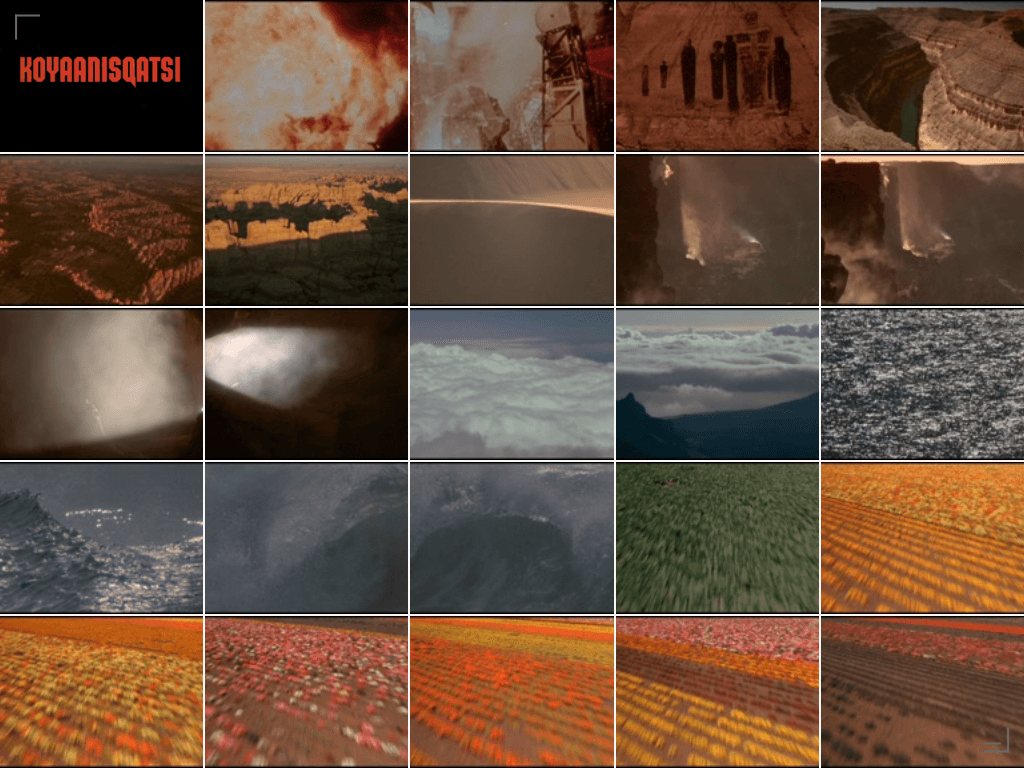
To Reggio, “unity imperatives” manifest in our reductive tendency to generalize, simplify and homogenize. To him, the celluloid film is about the negative becoming the positive; and negation is a way to resist destiny, to bring about change by learning to feel strange for what has become routine. Cinema and image-making would remain that liminal space to uphold perceptual estrangement, and camera presence, from within or outside our planet, to make concrete and visible the unseen.
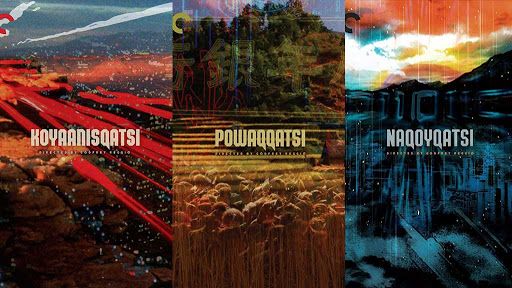
The Qatsi Trilogy
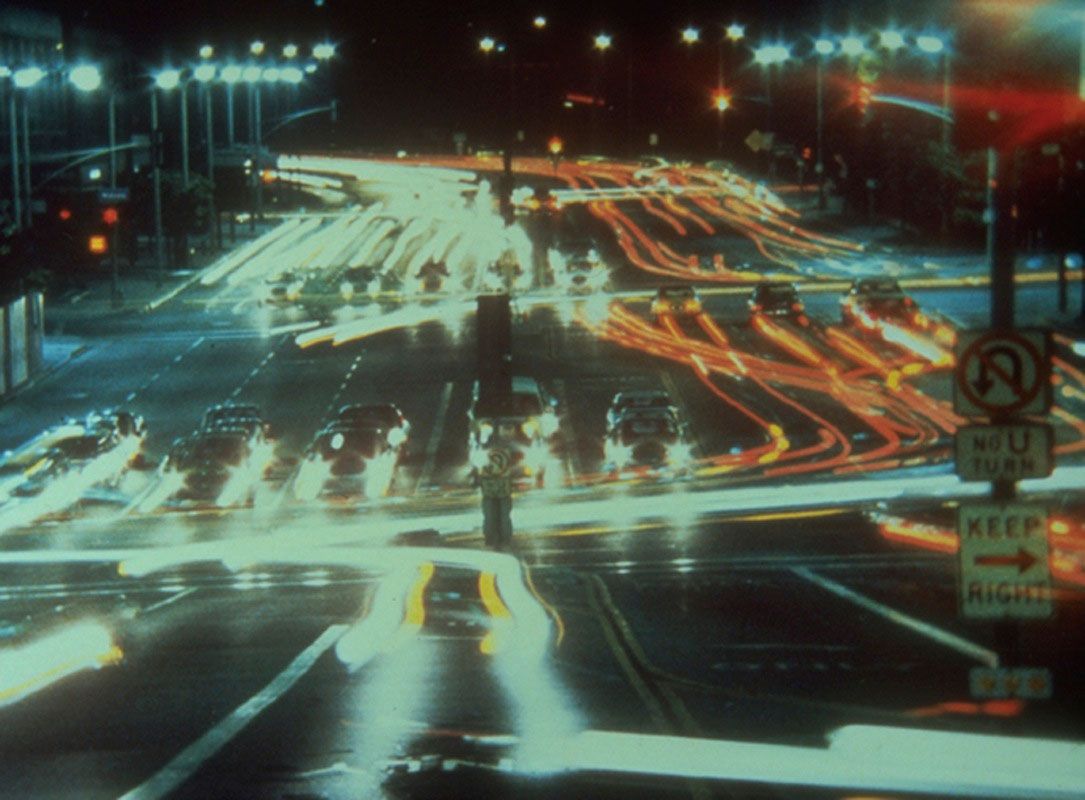
Koyaanisqatsi: Life Out of Balance (1983)
“We must become conscious through estrangement – not to follow the routine of life, being in the world but not part of the world,” Reggio annotates in retrospect the purpose of his trilogy. Life of Balance starts with familiar, highly circulatable and recyclable images streaming and braiding like they are the raw material of contemporary society: space ship, city, television, news media, consumer culture, highway, assembly line, collectivity, uniformity, crowds, streams of traffic, housing, destruction, industries, the state of floating, inaccessible territories… With all this he set up his own version of cross-disciplinary “systems theory” to make visible technology, our new nature, all inserted between the cave paintings of primitive society in the opening and ending of the piece.
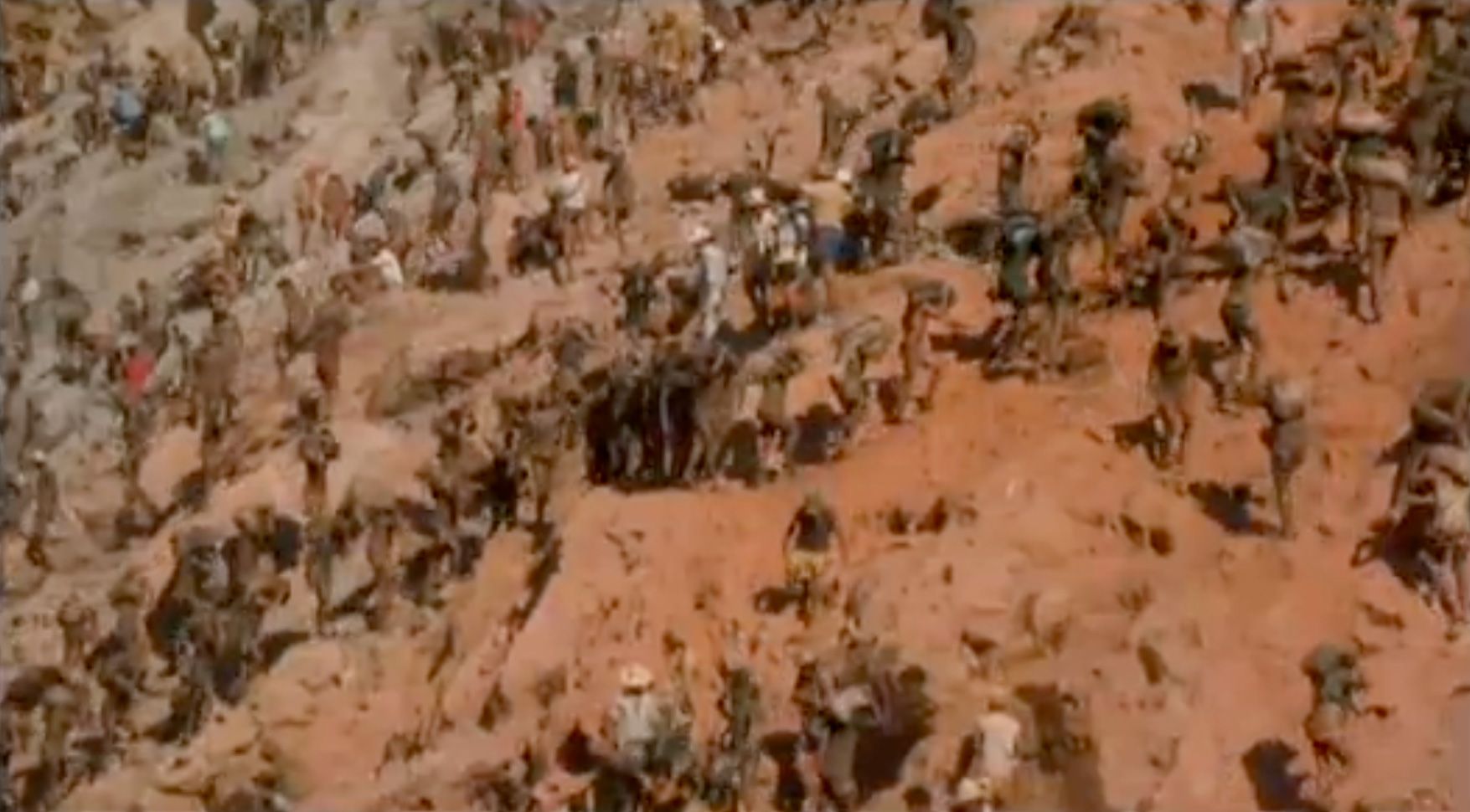
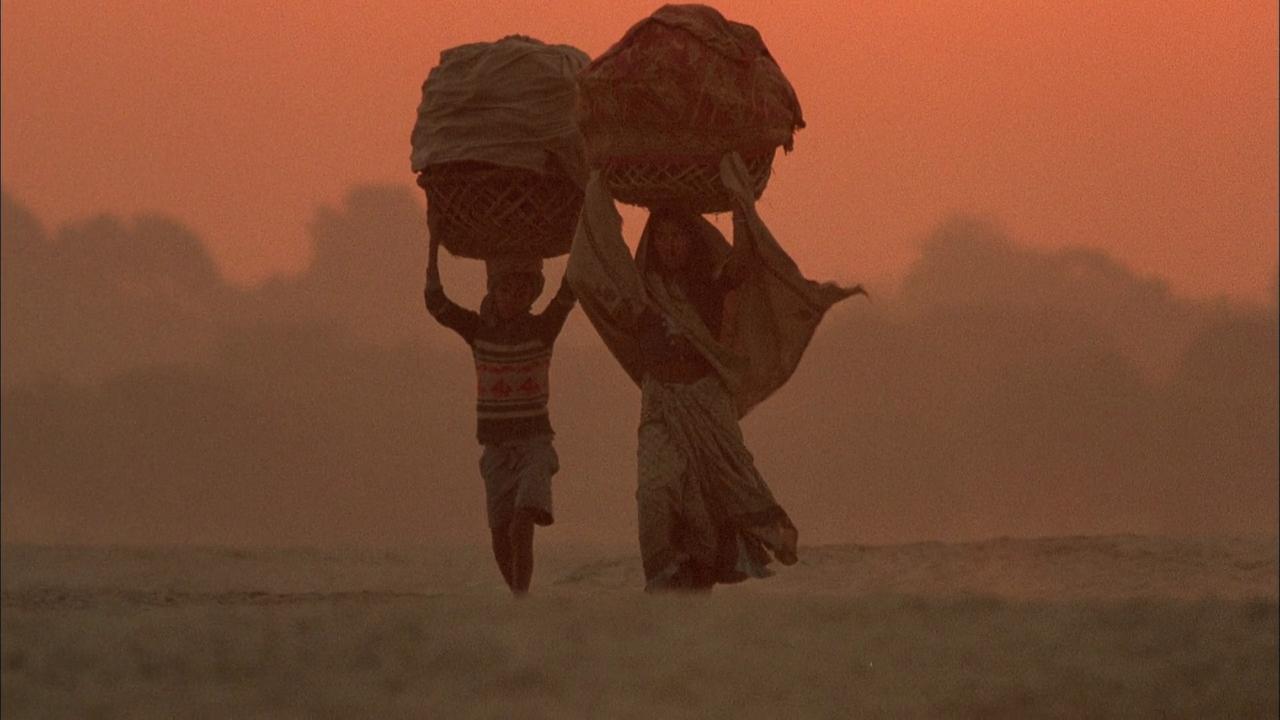
Powaqqatsi: Life in Transformation (1988)
In Life in Transformation, Reggio shifts from the Northern Hemisphere to the Third World nations in Southern Hemisphere. It opens with the emotive texture of slavery and hard labour, alternating between the choreographic of the laborers’ movement and shallow focu portraits of their enigmatic expressions. Is this the Roman Empire? Colonial exploitation? Or cinematic re-enactment? The rest of the piece is a meditative space of industrial landscape taking over natural landscape. Land cultivation is equivocal as much as urban development: is it good use of nature or the destruction of it? Reggio’s trajectory is at once synchronic and diachronic, historical and along a north-south split – his tongue-in-cheek proclamation of “transformation.” Philip Glass’ music continues to facilitate us to stay with Reggio’s image procession, like moving through a estranging ceremony.
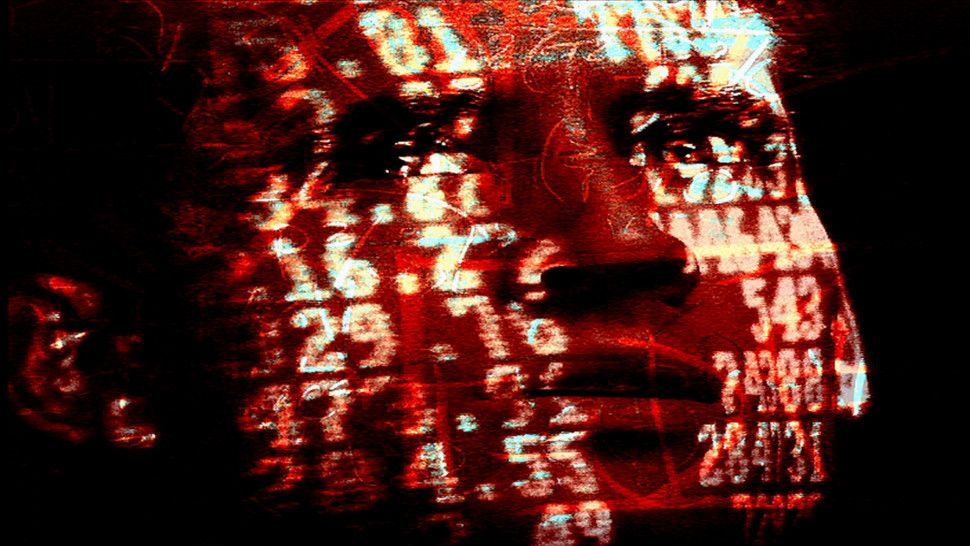
Naqoyqatsi: Life as War (2002)
“Naqoyqatsi” murmurs… a mournful announcement of life as war. We are thrown around and into the ruins of power -- dilapidated monumental buildings.
The meditative space places the viewer in the midst of forceful presences – positive images of ocean, history, climate and self-organized emergent landscape, interspersed with the (celluloid-)negative images of humans. Synthetic images take over – to the comfort of the contemporary viewer, or to dethrone us from the comfort of feet-on-ground haptic space? Are we already too used to military imageries and those of space conquer, which have long dominated our imagination? Points of view and perspectival space are deconstructed: is it really possible to move into the fractal space of mathematical concision, or the unseen space of domination? Objects enlivened by technology… Human faces turned technological (arti-)facts... Historical figures permanent circulatable simulacrums...
Reggio's vocabulary and its roots
visual vocabulary
vocabulary of progressive action
Interpolations
images – a world of layered vision…
anti-visuality
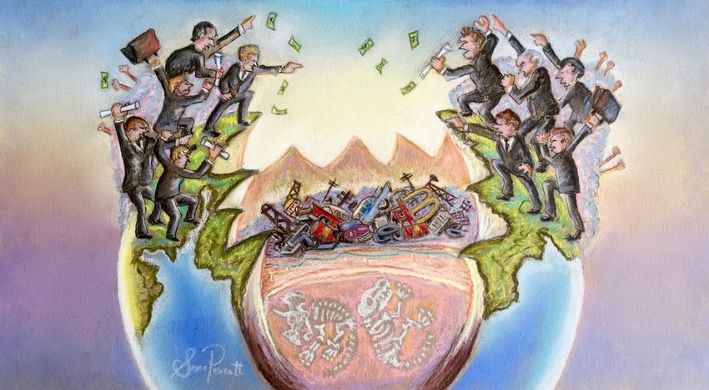
Why always reduced to personal ethics and moral responsibilities of the individuals only? … I find Susan Prescott's image speaks a thousand words.
Qatsi (2m27s), AI film, a tribute to Reggio's Qatsi Trilogy
[Qatsi | MIT AI Film Hack 2025] (Omi Bahuguna, Mark Chan, Yidi Zhou, Prisha Jain, Olivia Lee, NYU-ITP students)
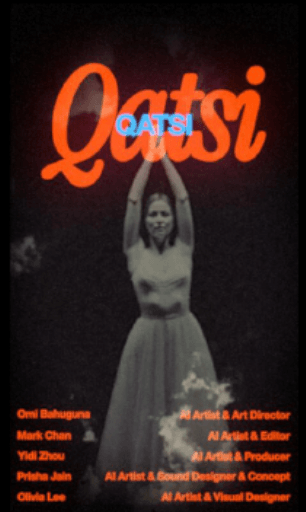
Qatsi, created in less than 48 hours for the 2025 MIT AI Film Hackathon, and uploaded 2 months ago, is an homage to Koyaanisqatsi (1982), the first of Reggio's “Qatsi” trilogy. On the level of visual content, Qatsi parallels the 1982 film's “visual exploration of motion as the axiom of life” — assembling images on the cosmos' vastness, nature's rhythm and the intimacy of human connection, from varied sources, including dance and movement. Salient similarities on the visual level is only the beginning in our understanding of the Qatsi (2025). The “flow of relationships, the inevitability of change, and the cycles of separation and reunion” are not limited to singular authorial intentionality; such existential theses are now subject to criterion-based data assemblage that speaks of potential continuity on a macro- and meta-narrative level. [note: I do not equate narrative with fiction story-telling as the term as been reductively use. I use the term “narrative” to describe procedural flows that construct and amount to additional meanings to the raw material. In this discussion, I use “narrative” to mean sight-and-sound discourses.]
What is AI film and why?
To call Qatsi a meta-narrative, that is, a narrative or image flow that is about existing narrative modes, is to seek connection of this work to the growing corpus of cinema. But AI media generation in video points to specific notions of creative freedom and creative resources to be tapped. The entire history of image-making, as long as it is made available on-line, forms the resource pool for a ready creator. As the MIT AI Film Hack team says,
“We believe creative AI will revolutionize storytelling, and our mission is to bring this power to everyone - so anyone can tell their stories.”
Qatsi and other films in the series are the result of makers hacking together and commbing different AI tools, including Autodesk’s Wonder Dynamics and Project Frames, Deemos' Hyper3DAI, HailuoAI, MeshyAI, and Molypix.
Qatsi is one of the works resulting from MIT Media Lab's collaboration with filmmakers to explore AI technologies, to incite a new movement in the making. So, what new potentials does it demonstrate?
According to a survey essay on recent advances in GenAI for film creation, Qatsi is cited as an example of how “visual imperfections in AI outputs — blurred edges, odd proportions, inconsistent lighting — can be repurposed as aesthetic features.” traditional post-production techniques remain
essential for polishing AI-generated visuals. Nonetheless, Qatsi deploys regular post-production steps whereby AI-generated abstract imagery is inteegrated with film grain and color grading, “grounding its ethereal montages in the tactile texture of early cinema.”
The preparation of a “library” for a system, or the operable “data” that forms the base, before computing begins, are now automated through machine learning and web mining. It seems the mega resource pool is infinite, and yet the question of internal generative reproduction data trained on often black-boxed criteria make us question the appearance of infinite resources.