
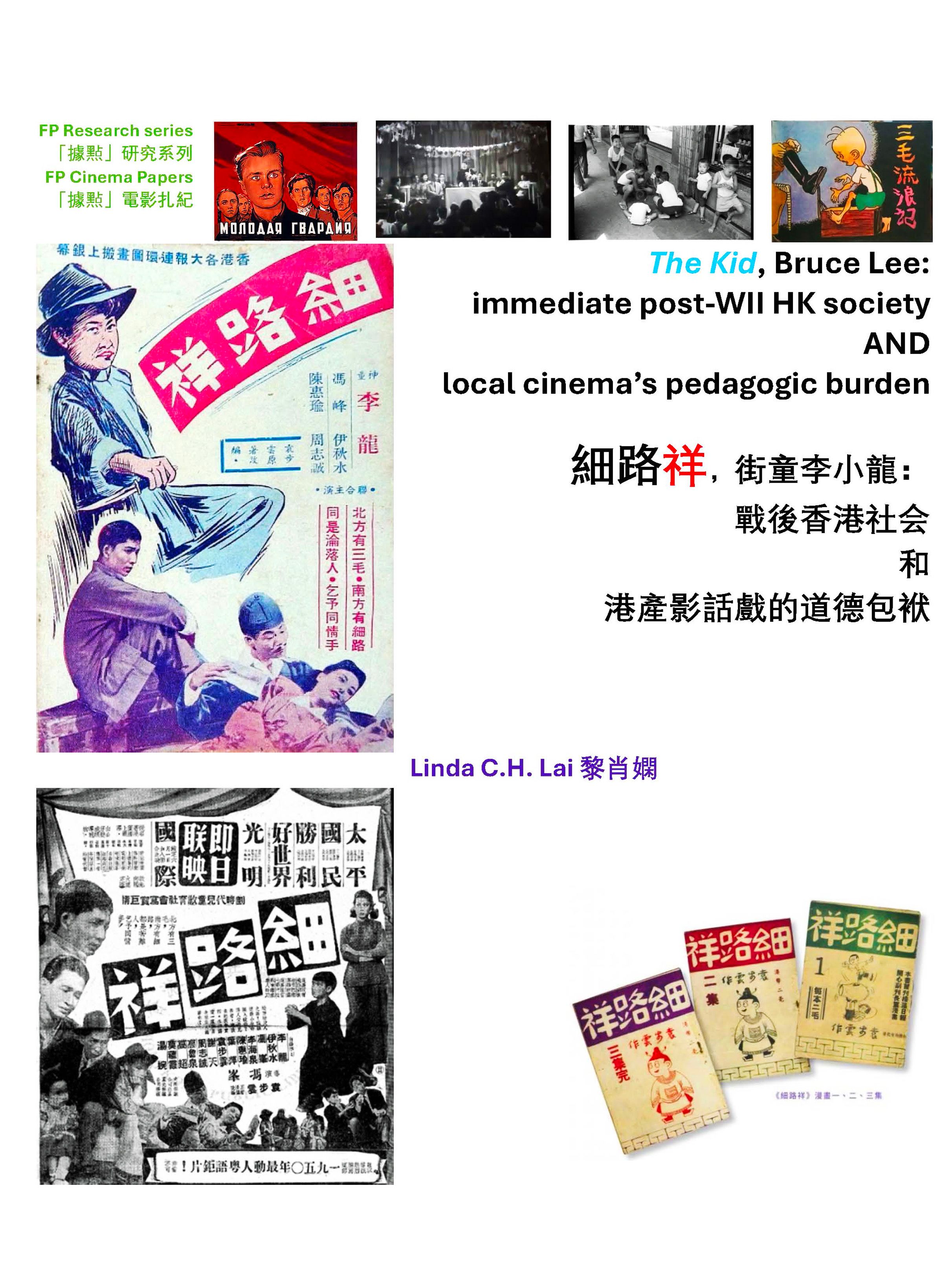
The Kid, Bruce Lee: immediate post-WII HK society & local cinema’s pedagogic burden 《細路祥,街童李小龍:戰後香港社會和港產影話戲的道德包袱》| Linda C.H. Lai 黎肖嫻 | 99 pages, bi-lingual 雙語 based on first-hand newspaper ad research | Floating Projects Research Series | Floating Projects Monographs ***available and on sale at Floating Projects.
有關香港「細路祥」三篇連載。2020-2021期間,黎肖嫻潛進環繞苦難中的孩子的沈甸甸而充滿矛盾的論述。
Cinema in history has never been pure entertainment even when the industry claims so. And never is power infiltration in cinema coercive: at the end of the pipe line a well told humanistic story is demanded, and it'd better touch people's mind and heart. From deliberate control through organizational agenda to well grossed entertainment through moral reasoning, cinema has the best illustration of social mechanism at work. It suggests we should move away from simplified accounts of power presence, at the same time pay attention to the fine fabrics of everyday life, of the way things hang together, without losing the broad view.
Around 2020-2021, amid suffocation, I felt the burden to articulate a response – and I did by drawing from HK’s cinema history. My sensibility landed on the horizon of kids and the meaning of education and its future.
Originally published as a series of 3 articles on Floating Teatime, Floating Projects’ writing platform, I revisited my research notes. My newspaper research pointed me immediately to the popular Shanghai-based saga of Three Hairs, which considered Cantonese oldie The Kid A-Chang as its HK counterpart. It was fueling quite a marketing battle, playing upon moralistic as well as patriotic sentiments among local audiences.
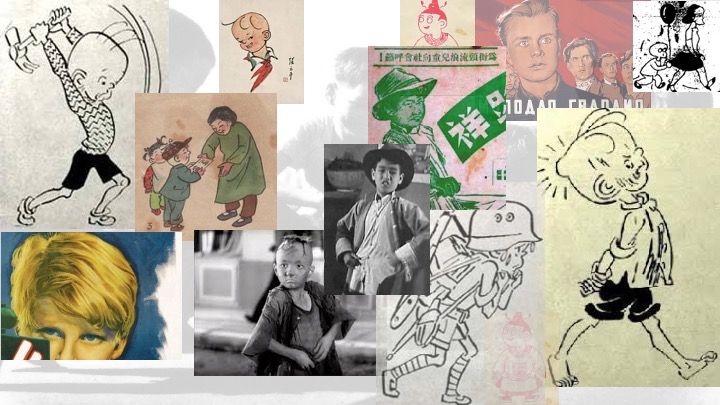
Is A-Chang a token of suffering? Is A-Chang who he is because of Bruce Lee’s highly acclaimed personification? Is A-Chang simply a counterpart of Three Hairs? Why do both cases of film adaptation drawn from comics, a specific form of literature (in war-time and the immediate post-war era) for people who could be illiterate?
I have often refuted the reflectionist model in the discussion of cinema in society. But this only means that there are many more ways to understand the many and complex meanings of filmmaking in our world. Films is a kind of quotable, just like our media never stop quoting from different kinds of experts. Cinema dramatizes reality, often by teasing out emotive muscles to magnify them. Films state a position, often as implicate persuasion through “arranging” the fate and consequences of characters’ actions -- melodramas, in particular, close with moral arguments. Films, as a unique form of technology, are cherished for their indexical transparency in preserving the looks of a city that could disappear in the process of urban renewal – we may say movies are deliberate or unintended quotations of urban space, as Walter Benjamin and Roland Barthes would see it.
Thinking as I write, in proceeding through the 3-part writing, I found my conceptual map illumining HK as not only a perennial battle ground for Communist-Nationalist (KMT) antagonism, but also the local government’s everlasting pacification politics, especially in maintaining a liveable home for the post-WWII new population. The 3-part essay ends with a hint on HK as a spy centre as always – why was there a movie ad on a Soviet film on young patriots on International Children’s Day in our local newspaper? And who were the target audience of Carol Reed's The Fallen Idol (UK, 1948)? Is it even a children film, or a literary exposition of the complexity of adulthood via the lens of a child whose failure to comprehend leads to his hero's downfall?
A bigger mystery yet hangs there in the air. Waiting for “Three Hairs” to arrive in the local cinema is like waiting for Godot. Three Hairs the movie, despite the endless hypes in local newspaper, did not arrive in Hong Kong officially until many decades later.
>>>>
In THREE chapters + 1 appendix
1.
A-Chang the HK kid: Interpolating Education, Interpellating the Child / 4
北方有三毛,南方有細路:1950 港產《細路祥》策問教育,召喚小孩 / 20
*中譯Wai-leung Lai 黎偉亮
2.
[Put away] The Kid on the Street, a prototype in HK Cinema / 28
街童上樓:大排檔、公屋,香港電影的民間典型 / 40
*中譯Wai-leung Lai 黎偉亮
3
Dramaturgy of social texts: the kid on the street, teenage Nazi-fighters, an eyewitness with a secret / 46
社會文本的劇場結構:回家歸國的街童,打走納粹軍的少年 ,不說謊的小孩見証人 / 46
**English Text with partial summary in Chinese
APPENDIX
我從摩羅上街地攤找到10 冊的《三毛流浪記》連環畫
I picked up The Wanderings of Three Hairs the Waif on Upper Lascar Row / 78
APPENDIX
我從摩羅上街地攤找到10 冊的《三毛流浪記》連環畫
I picked up The Wanderings of Three Hairs the Waif on Upper Lascar Row / 78