
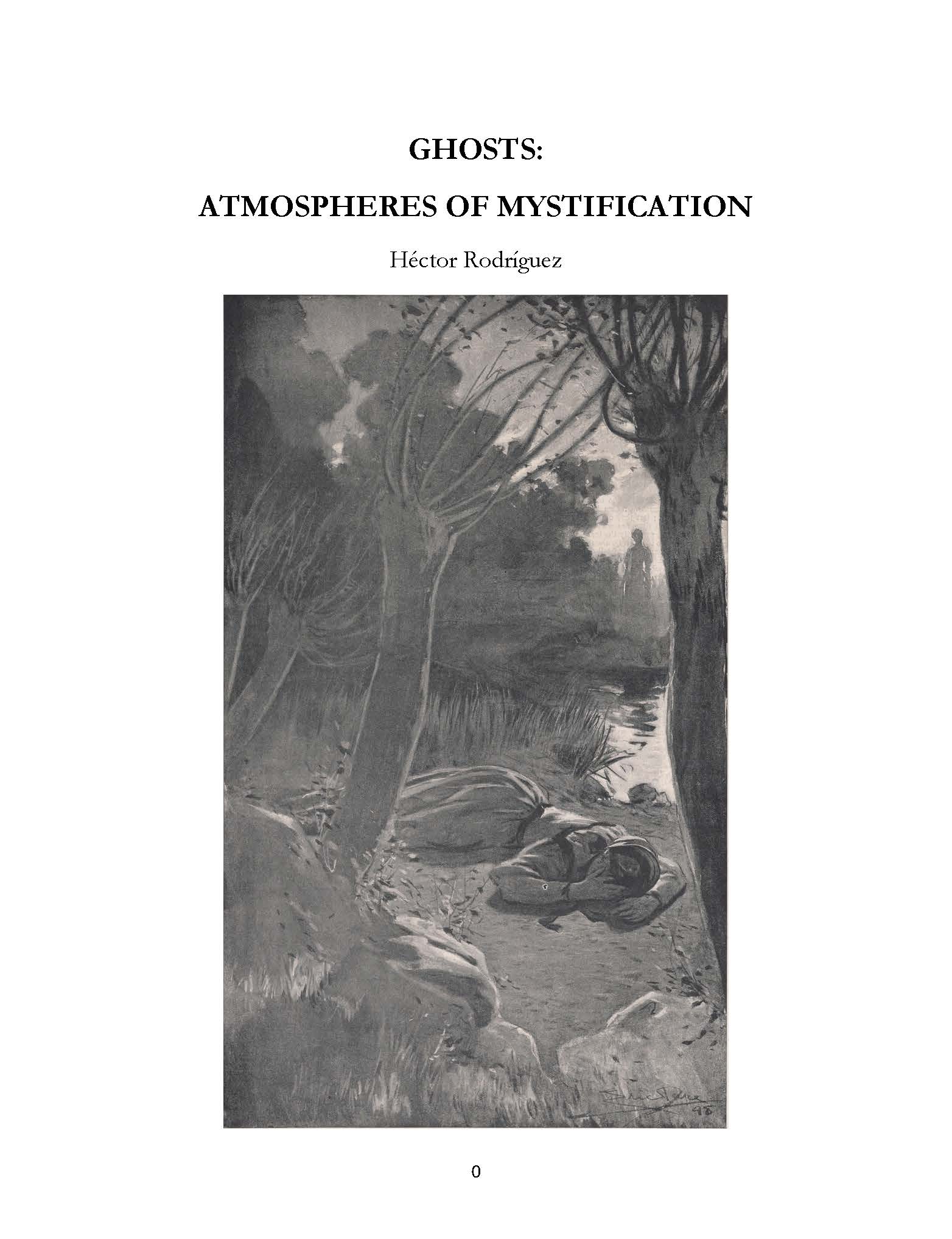
Ghosts: Atmospheres of Mystification | Hector Rodriguez, 95 pages | Floating Projects Research Series | Floating Projects Monographs ***available and on sale at Floating Projects
Focusing on two seminal ghost stories by Henry James, Sir Edmund Orme and The Turn of the Screw, this monograph explores some aspects of horror fiction. It is the first of an ongoing series of analyses focusing on the nature of horror in art.
James regards the ghost story as a modern variant of the fairy tale. The ghost story depicts events that depart from ordinary reality and an emotional quality that James calls mystification, the dissolution of familiar perceptual and cognitive frameworks, as experienced by a character who is at the same time a spectator of and a participant in those events.
Horror serves to transform our experience of everyday life by revealing another world that is at once very close to it and yet invisible to most of us. It therefore calls into question what belonging to a community is. The character who can see ghosts is different from everyone else in their community and yet must continue living with them.
James takes up a motif from melodramatic stories, innocents (young people and children) under threat, to sustain suspense, but also to question what innocence means in modern culture. The characters who see ghosts also regard themselves as being under a moral obligation to shield the "innocent" from any awareness of those ghosts. This requires the protagonists to act as if they could not see anything out of the ordinary. The strain of suppressed knowledge leads to a profound psychological crisis where the characters' fear is directed inward, monitoring their own fear while attempting to maintain a mask of normality.
Horror therefore becomes a second-order emotion. As characters anticipate the possibility of their own psychological collapse, they mainly fear that their own fear could eventually become unbearable. The horror of James's work lies in this impossible predicament, where the source of fear is not only the monster outside but also the instability of the self. This second-order fear can also be seen as a figure for the reader's own encounter with the plot. The reader is ideally afraid that their fear could at any point become too much to bear.
James' vision of horror depicts mystification as a complex rhythm of process and duration. James calls attention the fear of a monster in order to represent the unfolding and tonality of this emotion's emergence and growth.
This monograph is a close reading of the two chosen short stories, paying attention to the ways in which narrative structure and the use of language convey the experience of mystification. A method for reading short stories is also proposed, where the narrative is interpreted as the elaboration of a simple story, which serves as the starting point for the creative process. To analyze fiction is to reconstruct the ways in which the author transformed the starting story.
This monograph is meant for anyone interested in horror stories and in literature more generally. It is intended for readers without any prior knowledge of Henry James or of literary theory. The two stories under consideration are in the public domain and can easily be found online. This monograph can be read alongside the stories, as a guide to and commentary on them.