
It is Winter Solstice (冬至) today, the day with the shortest sunlight, as I start writing this piece as an introduction to Floating Projects’ mysterious film discussion of a 1961 ghost-story film by Hector Rodriguez.
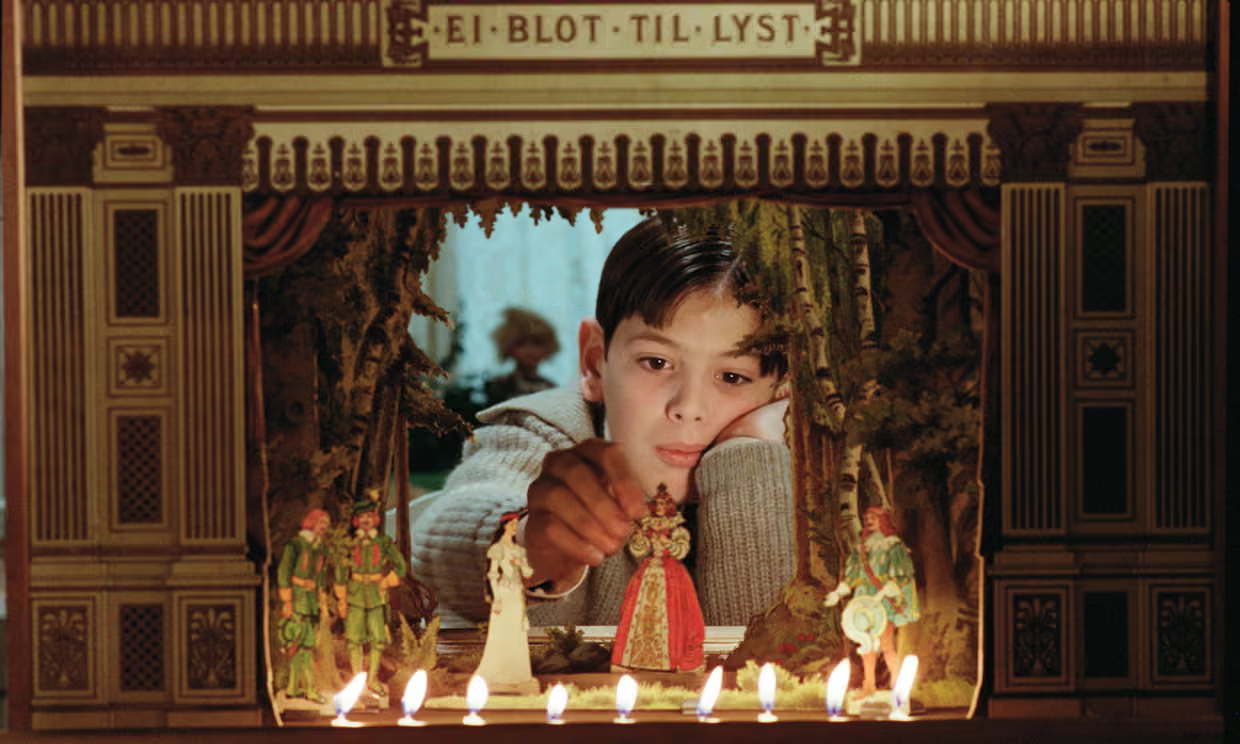
feature image: a scene from Ingmar Bergman's Fanny & Alexamder (1982).
In European traditions, telling ghost stories at Christmas is part of a broader cultural practice to cope with shortening daily sunlight into the dark, cold winter. Christmas and the winter solstice were linked because early Christians in the Roman period chose December 25th to celebrate Jesus’ birth (estimating 9 months from the Immaculate Conception of Jesus on 25th March, reportedly). By the 4th century, the celebration of Jesus' birth on December 25th became widespread in Rome. This aligns with the existing pagan winter solstice festivals such as Saturnalia and the birth of the Unconquered Sun, emphasizing the light of the world overcoming darkness, as days are getting longer after the winter solstice. Early Christmas customs also incorporated other hope-bearing pagan traditions like feasting, gift-giving, and the use of evergreens (plants like holly, ivy and firs) for decorations, suggesting resilience against winter’s darkness and the arrival of spring.
Border-crossing or defending boundaries
The pagan side of the ghost-story-telling tradition rests on the belief that Winter Solstice is that moment when the veil between the human and other worlds are thinning to allow the supernatural and the spirits of the dead to roam in the long, dark nights of the world of the living. [1] This reminds me of the 14th day of the 7th month in the Lunar calendar, when the gate of the underworld opens and the non-living crawls back to the world to get fed and to snatch those alive to join them – except that in southern part of China, Taiwan and Hong Kong, the focus is xxx in the form of a large scale gathering, a collective sacrificial ceremony to calm the dead and to ward off disasters, including praying (for the living), thanks-giving (to the gods that protect), purifying (a place), and pacifying (with the dead and the deities), a practice called “dajiao” (打醮). By comparison, the ghost-story-telling tradition in the West is about a short-lived attempt to cross the border to the other worlds rather than to strengthen the boundaries in our local practice.
In the UK, ghost stories as a Christmas-time tradition was popularized in the Victorian time in the 19th century (1837-1901), epitomized by Charles Dicken’s work A Christmas Carol (1843), among others, in which a lonely rich miser was shown his past, present and future Christmas by the spirit of an old business partner, rounding up in a note of moral goodwill celebrated. But the practice started at least a century earlier, when supernatural spirits were still considered a topic of serious scientific examination. [2] A key reference to sitting around the fire to tell ghost story from that period is the book Round about our coal fire: or, Christmas entertainments. (1732-34) [3] There is, of course, widespread citing of the character Prince Mamillius in Shakespeare's The Winter's Tale (1609-1611/1623) who says,
“A sad tale’s best for winter. I have one
Of sprites and goblins."
(Act II, Scene 1) [4]
R.S. Thomas's poem "Hallowe'en," part of his No Truce with the Furies published in 1993, offers a retrospective look of the traditions from a contemporary person’s summative, interventionist perspective, blending the real and the spiritual as an inseparable whole. Positioning the veil between the dead and the living on the Halloween, the poem explores the thin veil between life and death, the past and present, using the traditional night of ghosts to reflect on memory, loss, and the lingering presence of the departed in his austere Welsh landscape, warning spirits against returning to a world they no longer fit, a reflection of his spiritual depth and engagement with Welsh folklore and modern alienation. In “Hallowe’en,” the poet is talking directly to the ghost who is making an attempt to enter the other's world. [1] Festival doings in the evening is more than a fortune-telling event, but a performative action to deal with anxieties and tension between the loss of nature and rural life, and the living’s quest for soulful fulfilment, as they stare into the void of existence.
Anatomy of ghost stories: Thrills or psychoses; spirits or not
It would seem the anticipation of light and surviving long cold nights are inseparable. The fact is, living in the 21st-century, we may need some extra effort to feel its meeting. We may easily slight what it was like sitting through a long, cold winter evening to endure darkness when there was no electricity, thus the hope that candle lights and fire on wood would bring to pitch darkness. (Although the first home lit electrically was around 1878 in the UK, mass home adoption had to wait until the 1920s and 1930s.) Now we have to imagine a few friends and family members gathering, their sense of togetherness translating into body warmth, ignited by the scare of ghosts in their story-telling. This is the “mechanism” of staying warm.
What is the connection between “long, dark winter nights," “family gathering" around the telling of spooky stories as a (live) performance? What is the intuitive, expressive, psychological or objective link between ghost stories and the Christmas season? Let’s assume a few characteristics of the scenario:
*Perfect atmosphere. The long, dark winter nights and family gatherings created an ideal setting for spooky narratives, noted by writers like Shakespeare ("A sad tale's best for winter").
*Storytelling: Families gathered around fires to tell tales of ghosts, monsters, and ancestral heroes, bridging the darkness with stories.
*Remembrance: Stories served as a way to remember the dead and acknowledge the supernatural forces of winter.
From a more analytical point of view, the following is articulated about the anthropological significance of ghost-story-telling in one recent symposium (2019) I found on line, pinpointing the characteristics of ghost stories:
*“Boundary time" is important to all ghost stories: the winter solstice is the boundary between two “times”: the end of the days getting shorter and the beginning of the days getting longer." (Daniel Schenk) [5]
*Ghost stories are about Powerful objects, especially the battle between the power of the light and the power of the dark [5]
Of darkness versus light and glamour, I recall a few personal favourite horror films and ghost stories by which horror is most intensified when happening in well-lit rooms or in broad daylight.
There is my favourite Ingmar Bergman film Fanny & Alexander (1982) in which the emphasis of warmth and light is to anticipate cold and darkness. Fanny and Alexander’s bourgeoise home is full of joy and magic with a big Christmas banquet. They tell their own self-created ghost stories to each other. In a lazy afternoon, Alexander saw Death walking through the living room. Through buzzing conversations, Alexander saw his dead father watching and staring at the family in his blazingly white outfit, referencing Shakespeare's Hamlet talking to his father’s Ghost, with ghost relatives hanging out with those alive. And yet the glittering lights in the warm Christmas home is simply one-step away from the death of their father, taken over by their fright and terror in a cold, bleak, cruel Protestant home of their step-father’s, deprived of toys and decorations. The abusive punitive treatment of the children, especially Alexander, is all in broad light in scenes of family education. In a casual conversation, two dead girls talk to Alexander in his room about how they were murdered.
Often linked with ghost stories, horror does not necessarily grow out of darkness the glamorously lit hall and corridors of the Overlook Hotel in Stanley Kubrick's The Shining (1980) where ghosts all gather in their party outfits in the ballroom. In broad daylight in a tall-ceiling hall swarmed with sunshine, the main character types piles after piles of pages of the same line in different layout formats -- “all work and no play makes Jack a dull boy” – and that is all the devoted work he claims as the reason to shut out his son and wife. Darkness, accompanied by an extreme snow storm, only occurs in the final sequence of escape.
And yet of an extreme case of darkness and the ghostly domain, I cannot help thinking of the mood in Alejandro Amenábar's The Others (2001). Sunlight must be reduced to the use candle lights in pitch darkness reinforced by thick curtains, day or night. In the dimly candle-lit sessions of evening story-telling, the children could only read the bible or orally recapitulate Dante's “Inferno” in his Divine Comedy, the only way Mother (played by Nicole Kidman) could ensure her boy and girl's survival, not knowing that they have in fact all died and would “live” in the house only forever.
The charm of telling and listening hinges on the art of “descriptions.” Many ghost stories, though pre-existing cinema, deploy mise-en-scene like descriptive dynamics, constantly zooming in and out of details, alternating between descriptive haptic-spatial view and narration, that is, summary, shortening and against the larger backdrop). Moving through space is hand in hand with description of the surroundings. Sounds, too, are often turned into descriptive objects; or sound description is itself drama. The real protagonist is the environment, such as a house or a garden, and sight and sound a character or characters. The physical world is personified often to the degree that human characters are functions of the physical world: they often occupy the position of passively responding to their surroundings and the sighting-hearing of things unreal. [7]
There is yet the question of narrative truth as opposed to beliefs (or not) in the existence of ghosts. Narrative truth rests on coherence within the story world, meant to be the subject of persuasion by an author. But the fact that things (and ghosts) make sense within a story does not mean they are materially true. A well told ghost story would move us away, while listening or reading, from the burden of ghosts’ existence as a debate which fuels the writing of ghost story.
Narrative truth, however, could itself be the subject of enquiry. A ghost fiction could suspend the question of ghosts’ existence by focusing on the art of description to make a fictional world believable. It may also question the sources of our subscription to ghosts’ presence, or place the focus on human’s perceptual experience, including possible pathologies of the mind. It may also embrace ambiguities, refusing to settle on a definite status, or final explanation, for things in our perceptual realm.
“It was difficult to differentiate between what was fantasy and what was … real.”
Describing his film Fanny and Alexander (1982) as a re-construction of his boyhood, director Ingmar Bergson says, quoted in Wikipedia’s production notes:
It was difficult to differentiate between what was fantasy and what was considered real. If I made an effort, I was perhaps able to make reality stay real. But, for instance, there were ghosts and specters. What should I do with them? And the sagas, were they real?
Indeed, if the magic lantern, a piece of technology-turned-toy, had been part of a kid’s everyday life in a 19th century bourgeoisie home, then what was projected in the dark and the contents, often folklores, attached to the machine had also formed a child’s general experience and consciousness of the world. As I read it, the dramatic conflict of Fanny and Alexander evolves around truth versus lies and truth versus fantasy, thus also the question: fantasy = lies? And is there any way to resolve the difference between those see what is real and those who see “more than” …? Alexander, the admitted momentary surrogate of Bergman himself, lives a life in which what he sees “more than…” was not confined to private imagination, but acted upon to affect the passage of life in actions. And Bergman added that there is in fact a lot of him in the character (Bishop) that punishes the boy who speaks of his fantasy; in saying this, Bergman admits he is haunted by his own devils.
There was no questioning of the presence of ghosts in M.R. James’ Ghost Stories of an Antiquary in 1904. [6] His ghost stories emphasized clear scares without ambiguity of truth, nor do they highlight any graphic gore. Take The Ash-Tree as an example. [7] The narrator, also the writer M.R. James himself, starts out with detailed description of a town in East English as if he is taking reader for a walk, to look up and down, up-close an afar, to hear and smell and to follow the contours of the landscape; and he assures us that whoever has visit that area would have agreed with him. The narrator then suddenly reminds us not to forget that it is him speaking with a specific purpose. The second paragraph opens,
But this is a digression. I have to tell you of a curious series of events which happened in such a house as I have tried to describe. It is Castringham Hall in Suffolk …, but the essential features I have sketched are still there—Italian portico, square block of white house, older inside than out, park with fringe of woods, and mere. … At any rate, it had well-nigh attained its full dimensions in the year 1690.
In that year the district in which the Hall is situated was the scene of a number of witch-trials. It will be long, I think, before we arrive at a just estimate of the amount of solid reason—if there was any—which lay at the root of the universal fear of witches in old times. Whether the persons accused of this offence really did imagine that they were possessed of unusual power of any kind; … were extorted by the mere cruelty of the witch-finders—these are questions which are not, I fancy, yet solved. And the present narrative gives me pause I cannot altogether sweep it away as mere invention. The reader must judge for himself.
Such a long introduction is to advise that it is not a matter of what we are ready to believe or not: it did happen, was witnessed, and credulity is not the condition for what is real. And this notion of the empirical real is emphasized through the strict chronological order of events, from 1690 to 1754, disregard the multiple failure to prove the strange happenings scientifically. Along this line of thoughts, ghosts are not just supernatural: they are restless souls and spirits with unsettled injustice wronging them.
We may also look for A Ghost Story for Christmas -- a strand of annual British short television films originated between 1971 and 1978 to be broadcast on BBC One, which was revived by the BBC since 2005 – to sort out the premise of their stories. Six of the series’ initial episodes are based on M.R. James’ work such as Room No. 13, The Ash Tree and Whistle and I’ll Come to You (which adopts the title of a poem by Scottish poet Robert Burns. Other authors include Charles Dickens’ Signalman, Arthur Conan Doyles’ Lot no. 249, E.F. Benson’s The Room in the Tower and J. Sheridan Le Fanu’s Schalcken the Painter, and original story by more recent writers Clive Exton (Stigma, 1977) and John Bowen (The Ice House, 1978) and more.
In the BBC-TV adaptation of M.R. James’ The Ash Tree, [7] the multiple narratorial frame is equally at work. The visual narrative starts with a voi8ce-over telling the telling of a ghost story about an ash tree. Rather than highlighting the reported speech nature-of the story teller’s accounting, the third person is in fact an authority of antiquary as a Cambridge professor, and the writer M.R. James himself played by Christopher Lee. While the professor describes the account as a strange event, the VO that introduces him reinforce the authority of truth instead of staying open whether one wants to believe in it or not. It must be pointed out that a large part of the 28(?) minutes has the camera looking at the professor accounting for the events to his Cambridge students around the fire place, with occasional inserts of the narrated event in the form of still shots that highlight the atmosphere, partial views of a location, and occasionally illustrated reports in the early 18th century. This treatment is more on the forensic side, and may not fit the horror norms of thrills and scares. But I personally find this open-ended impressionistic account calling more attention to the potential epistemological crisis of the witch-hunt.
Bergman’s Fanny and Alexander and M.R. James’ short stories and moving-image adaptation defend ghosts and spirits against rational-moral annihilation of their existence. They are in contrast with Henry James’ The Turn of the Screw (1898), also associated with the Christmas ghost-storytelling tradition, which takes us closer to the possibility of a psychotic situation in what we often call psychological horror, and this applies to its 1961 film adaptation. Though also deploying multiple narratorial frame of the third person, James’ The Turn of the Screw places the whole story on the threshold of truth and mystery. From its offset, Henry James topples narrative stability by inscribing narration within the framework of someone narrating an event as it was reported to him.
[*This is also the subject of Hector Rodriguez discussion in a recent Floating Projects pre-Christmas event. (See final section of this article).]
What about the movie The Innocents (1961, Jack Clayton), adapting Henry James’ The Turn of the Screw?
In Henry James’ original novella The Turn of the Screw, he clearly establishes the work as a case for open enquiry though multiple narratorial mediation. Hector Rodriguez, in his introduction to Clayton’s The Innocents at Floating Projects (2025.12.23), teased out the layers: “the narrator of the prologue hears the story from a man named Douglas” who “is not the one who experienced the story” as the account “has been written down in the first person by the woman who experienced it” and who is dead when Douglas speaks. This opens up the space for readers to raise questions and make their own decision how to make sense of what happens. This is yet complicated by the fact that Douglas and she share the story as they are fond of each other.
Rodriguez quotes James, illumining the place of language in ghost narratives:
“All life therefore comes back to the question of our speech, the medium through which we communicate with each other, for all life comes back to the question of our relations with one another.”
The tone or atmosphere to be sustained is one of mystification:
“...the study is of a conceived "tone," the tone of suspected and felt
trouble, of an inordinate and incalculable sort, the tone of tragic, yet
of exquisite, mystification".
Mystification is the sense that something is wrong, something is
unsettling, but cannot be directly described or explained.
The material must be uncanny and unknown but it must be
described with the outmost precision. Henry James aspires new kinds of ghost stories. But he notes that there was a new type of ghost stories which he did not want to take as a model: he notes a growing contemporary trend that based the narration of ghosts based on psychical research. In his view, this “new type” -- the modern "psychical" case -- is "washed clean of all queerness as by exposure to a flowing laboratory tap, and equipped with credentials vouching for this" but “the more it is respectably certified, the less it can rouse the dear old sacred terror”. James rejected this scientific approach, but nonetheless drew on psychical case study materials.
According to James, Ghosts just walking around are not scary. The point is not just that the living somehow come across the ghosts but that the ghosts should actively intervene in the world of the living with a malignant purpose. Ghosts are predators; their action must express a villainy of motive, or else the work would be trivialized. The danger of ghosts is that they may not seem sufficiently bad: their evil manifests a specific compass of brutality or immorality.
REFERENCE
[1] R.S. Thomas's poem "Hallowe'en": https://ramblingatthebridgehead.wordpress.com/2018/10/30/halloween-by-r-s-thomas/
[2] “Forgotten Tradition: Chilling Christmas Ghosts" [link to video]
https://www.youtube.com/watch?v=5n6oSoEatJQ
[3] Anonymous author: Round about our coal fire: or, Christmas entertainments (first published 1734). The book offers glimpses into traditional fun of English Christmastime, including fireside tales (such as an early version of Jack and the Beanstalk), songs, games, magic, hospitality customs and superstitions, and memories of old Father Christmas, among other holiday lore. The book can read on Internet Archive:
https://archive.org/details/bim_eighteenth-century_round-about-our-coal-fir_the-dedication-signed-d_1796/page/n7/mode/2up
[4] Shakespeare’s A Winter’s Tale: quote from Act II, Scene 1: https://www.folger.edu/explore/shakespeares-works/the-winters-tale/read/2/1/
[5] “Ghost Stories for the Winter Solstice”; Signum Symposium, Signum University, 21 December 2019. https://www.youtube.com/watch?v=eQMevdgqTZA
[6] M.R. James: Ghost Stories of an Antiquary (1904), a collection of ghost stories by British writer Montague Rhodes James. According to Wikipedia, “some later editions under this title contain both the original collection and its successor, More Ghost Stories of an Antiquary (1911), combined in one volume.”
[7] To read M.R. James’ “The Ash Tree” (1904) in Ghost Stories of the Antiquary, visit:
https://en.wikisource.org/wiki/Ghost_Stories_of_an_Antiquary/The_Ash-tree The first 100 lines of the writing is already sufficient to show the shuttling between detailed descriptions of the place, accounting of what happened, reasoning and questioning, that is, the in and out with the third person and the first person.
[8] To watch The Ash Tree (by M.R. James), adapted by BBC in “A Ghost Story for Christmas” series, visit: https://www.youtube.com/watch?v=r9o5s1w4Wv8