
Searching for tag: historical-research
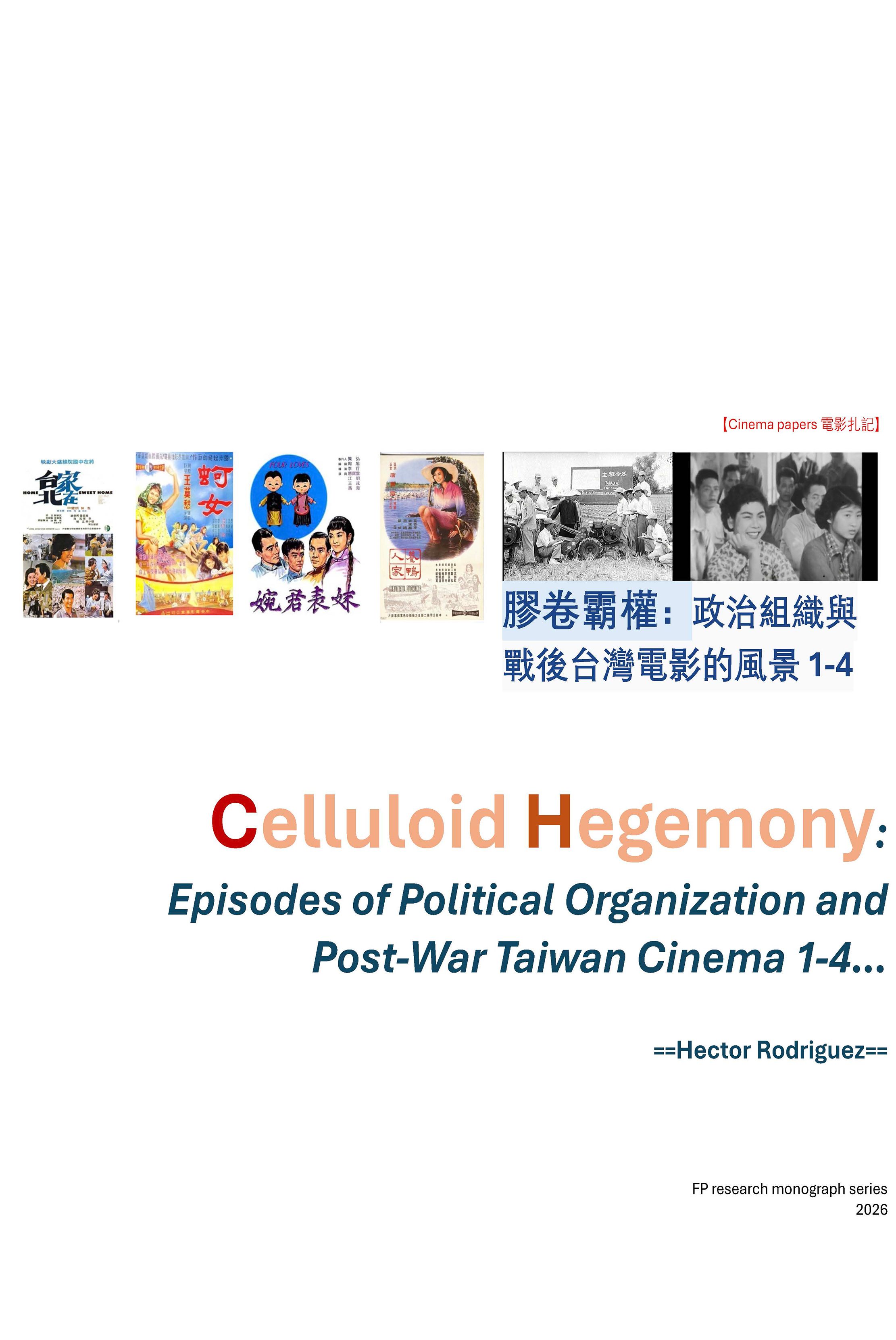
Celluloid Hegemony: Episodes of Political Organization and Post-War Taiwan Cinema 1-4 《膠卷霸權:政治組織與戰後台灣電影的風景 1-4》/ Hector Rodriguez
This monograph explores Taiwan in the 1960s when cinema was a site of cultural expression as much as a contested apparatus for the manufacture of political mythologies highlighting a new home and modern society.

Linda Lai / Bruce Lee the kid on the street, teenage Nazi-fighters, a brave boy the only eye-witness 不再瓢街回歸祖國的細路祥,打走納粹軍的少年 ,謀殺案的唯一孩童證人
A follow-up on “[put away] the kid on the street” (2 August 2020), Linda Lai continues to examine how, in an apparently peaceful post-war moment of Hong Kong in May 1950, three local film distributor-exhibitors fought for audiences of movies named to be celebrating the Children’s Day, with very different ethos. 倫敦謀殺案的唯一孩童證人。這不是一般的電影分享或分析,透過跨文本的觀察,試圖理解電影在社會生活世界中與別的範疇可有的種種協作果效。港產《細路祥》(1950)、蘇聯兒童片《以身許國》(1948)、英國電影童星主演的《妒花風雨》(1948),成為太平盛世的香港慶祝兒童節的電影宣傳搶客戰。
\n![Linda Lai / [Put away] The Kid on the Street, a prototype in HK Cinema 街童上樓:大排檔、公屋,香港電影的民間典型](https://fpchk.s3.ap-southeast-1.amazonaws.com/Kid_duckling_2216577df7.jpg)
Linda Lai / [Put away] The Kid on the Street, a prototype in HK Cinema 街童上樓:大排檔、公屋,香港電影的民間典型
In the second of a series of field notes as short essays, Linda Lai continues to craft possible histories of Hong Kong’s everyday interiority through the lens of “intelligentsia” responses within the filmmaking community in the immediate post-WW2 years. 一連三篇由「細路祥」出發的第二篇:黎肖嫻繼續探討「細路祥」化身銀幕上,成為了甚麼樣的文化資本。小孩所牽連的是一張複雜的管治的權力網。
\n
Linda Lai / A-Chang the HK kid: Interpolating Education, Interpellating the Child 北方有三毛,南方有細路:1950 港產《細路祥》策問教育,召喚小孩
In a series of 3 articles, Linda Lai shares her field notes in film studies from a Cultural Studies perspective. The first discusses the kid A-Chang (1950), a HK counter-part of Shanghai’s Three Hairs 1940s. 有關香港「細路祥」三篇連載的第一篇,黎肖嫻潛進環繞苦難中的孩子的沈甸甸而充滿矛盾的論述。
\n