

In the last of a 3-part extended discussion on The Kid, Linda Lai continues her inter-textual study of commercial movies understood as social texts and pedagogic apparatus, through three sets of marketing activities competing for audiences who were celebrating the Children’s Day, asserting very different ethos. 倫敦謀殺案的唯一孩童證人。這不是一般的電影分享或分析,透過跨文本的觀察,試圖理解電影在社會生活世界中與別的範疇可有的種種協作果效。港產《細路祥》(1950)、蘇聯兒童片《以身許國》(1948)、英國電影童星主演的《妒花風雨》(1948),成為戰後重拾呼吸的香港慶祝兒童節的電影宣傳搶客戰,拋出不同的消費道德教化的產品。
\n**featured image: Four juxtaposed ads on 1 June 1950 (from L to R): The Kid (HK, 1950, dir. Fung Fung), The Fallen Idol (UK, 1948, dir. Carol Reed), A Common Soldier (USSR, 1948, dir. Sergei Gerasimov) and Cathay Cinema’s announcement of its celebration of the International Children’s Festival with A Common Soldier. Newspaper research by Linda Lai.
\nIn this article, I examine how, in an apparently peaceful post-war moment of Hong Kong in May 1950, three local film distributor-exhibitors fought for audiences of movies named to be celebrating the Children’s Day, then set on 1st June of a year. The marketing competition in question involves the local HK kid (played by Bruce Lee) whose dream to be good could only be fulfilled by returning to “pastoral” China, a young soldier in the Soviet Union who summoned other teenagers to save their town from Nazi attack, and a British boy who was the only eye-witness for a murder. My interest is drawn to how specifically how a commercial film melodrama was “volunteered” to be offering an urgent moral behavioural model of everyday self-techniques.
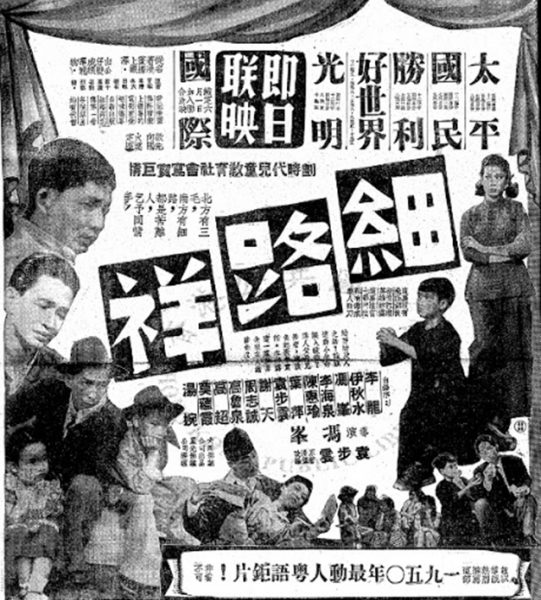
\nIt was late May 1950. Commercial film exhibitors were in keen competition to ensure maximum box office return as the International Children’s Festival was drawing near. Imagine going to the movies for a special celebration for children: two tickets for four persons. It was a time in post war colonial Hong Kong when an adult was allowed to take a kid with them to the cinema as long as the kid could be placed on an adult’s lap. Newspaper ads of the time indicate how The Kid (aka My Son A-Chang) was entangled in tough competition when it was first released on May 31 of the year. The first “coming soon” ads appeared in a few major Chinese-language newspapers on May 28, three days before the film was premiered in six movie theaters. The last ads were read on June 3, when the film was said to be shown in day-time slots only “due to contract arrangements.” Was this purely a marketing trick boosting a sense of urgency so more people would come the soonest possible? One imagines the film’s marketing personnel burdened with alleviating box office threats from three other competing films.
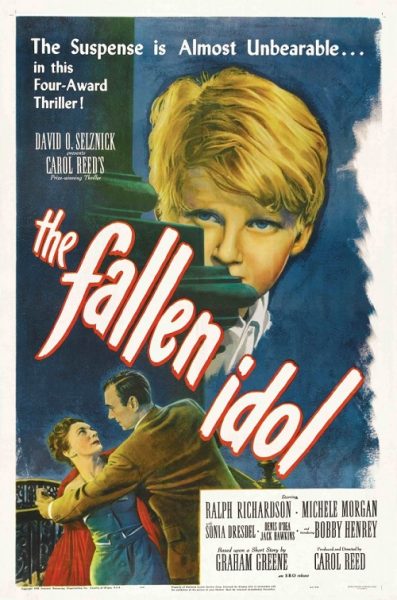
\nReleased on the eve of the International Children’s Festival, The Kid highlighted not only its focus on children, but also its turning a story originally in comics into live actions. From overseas, the main competitor was A Common Soldier (which should be The Young Guard, 1948, according to my research), a battle film from the Soviet Union’s Children Film Studio, dubbed in Mandarin, and billed as Cathay Theatre’s special presentation “for all children in Hong Kong and Kowloon” to celebrate the festival. Contents of the Soviet film’s ads uphold an exemplary model for young people’s dutiful sacrifice for one’s nation. The second competitor was The Fallen Idol (1948, dir. Carol Reed) by London Film Productions and British Lion Film Corporation. Scripted by literary writer Graham Greene and based on his own short story The Basement Room, the film highlights its “talented child actor” Bobby Henrey. As for the third competitor, Shanghai production The Winter of Three Hairs [San Mao Liulang Ji, aka An Orphan on the Streets, or The Adventures of Sanmao the Waif, and San Mao, le petit vagabond in France] (1949, dir. YAN Gong, ZHOU Ming), the film’s selling point was the its faithful preservation of its original comics style. And its movie ad screams, “Funnier than comics – minimum dialogues, maximal actions.” Thus openly stated in the movie ads of the HK-made The Kid, “In the north there is Three Hairs, in the south there is the Kid,” equating Hong Kong (south) with Shanghai (north).
\nHow did the makers of The Kid differentiate the film from its competitors? The Kid does not laud any easy solution for national ills, unlike the call for the national subjects’ full individual commitment in A Common Soldier. It makes no attempt to create a world of lies and deception perceived through a child’s eyes (Fallen Idols). Though “The Kid” and “Three Hairs” were both based on well-known comics, the former deploys no physical comedy of performative humor vivid in the latter. The Kid is a heavy social realist drama duly softened by the fresh performance of a few kids including Bruce Lee’s. It anticipates Zhonglian’s social realism of literary proclivity in the 43 films they produced in 1953-1964. [3]
\nInterpolating Education, Interpellating the Child 召喚教育,策問小孩:北方有三毛,南方有細路。
\n1950. Communist China was founded less than a year ago. There was no border control yet between China and HK (until June 1951). n six post-WWII years, 1945-1951, the population of Hong Kong rose from 600,000 to 2.1 million (Wikipedia)*, suggesting the sudden surge of refugees from the mainland prominently restructured the colony’s population. While housing was an obvious challenge, many immigrants, including children, became cheap labour for post-war economic recovery. Cantonese film The Kid (1950, dir. Fung Fung) happens to hold up a microcosm in which many contradictions of recovery, capitalist logic, unemployment, class split, social integration and schooling problems were dramatized.
\n*six hundred thousand in August 1945 (Endacott 1978: 142) to an estimated 2.36 million by March 1950 (Welsh 1997: 438),
\nIt was late May 1950. Commercial film exhibitors were in keen competition to ensure maximum box office return as the International Children’s Festival was drawing near. Imagine going to the movies for a special celebration for children: two tickets for four persons. It was a time in post war colonial Hong Kong when an adult was allowed to take a kid. …
\n\n
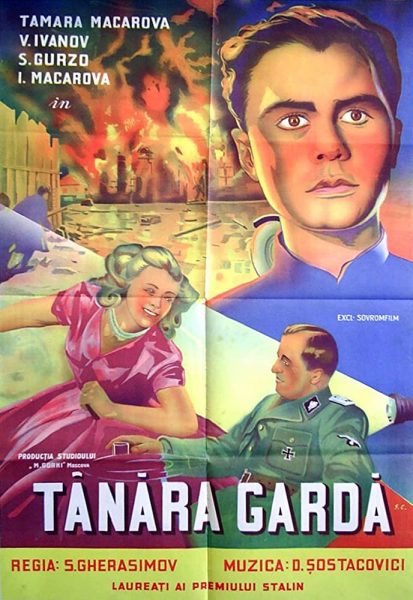
***A COMMON SOLDIER, according to my research, should be Sergei Gerasimov’s The Young Guard, billed “children film” (兒童片) was classified war film made to answer the need for cinema enhancing its role in promoting national patriotism in USSR (Union of the Socialist Soviet Republic, now Russia)
\nTHE YOUNG GUARD is based on a novel of the same title. Set in 1942during the Nazi occupation in the city of Krasnodon, Russia, the film portrays how courageous local teenagers organized underground resistance to outsmart the Nazis by blowing up the latter’s recruitment offices. Lifting the spirits of the surviving citizens, they then gather other school-friends in groups of five to help many others to survive.
\nJoseph Stalin (1924-1953). 1924-1940 (2nd 5-year plan) – Those that owned land or livestock were stripped of their holdings. Hundreds of thousands of higher-income farmers, called kulaks, were rounded up and executed, their property confiscated. … agricultural productivity dropped, leading to devastating food shortages … Millions died during the Great Famine of 1932-1933. … The Ukrainian famine—known as the Holodomor, a combination of the Ukrainian words for “starvation” and “to inflict death”—by one estimate claimed the lives of 3.9 million people, about 13 percent of the population. 1936-38 the Great Purge: Stalin eliminated all likely opposition to his leadership by terrorizing Communist Party officials and the public through his secret police. … an estimated 600,000 Soviet citizens were executed. Millions more were deported, or imprisoned in forced labor camps known as Gulags.
\nIt was the Cold War period when the film was made. Following the surrender of Nazi Germany at the end of World War II, the uncomfortable wartime alliance between the Soviet Union and the United States and Great Britain began to crumble. The Soviet Union by 1948 had installed communist-leaning governments in Eastern European countries that the USSR had liberated from Nazi control during the war. The Americans and British feared the spread of communism into Western Europe and worldwide. In 1953-54 new reel, Khrushchev and de-Stalinization (1953-59)
\nSoviet cinema in the postwar era: The Soviet film industry suffered during the period after World War II. On top of dealing with the severe physical and monetary losses of the war, Stalin’s regime tightened social control and censorship in order to manage the effects recent exposure to the West had on the people. The postwar period was marked by an end of almost all autonomy in the Soviet Union. “A resolution passed by the Council of Ministers in 1948 further crippled the film industry. The resolution criticized the work of the industry, saying that an emphasis placed on quantity over quality had ideologically weakened the films. Instead, the council insisted that every film produced must be a masterpiece for promoting communist ideas and the Soviet system.”
\nSergei Gerasimov’s The Young Guard. He was commissioned to produce screen versions of the literary classics of socialist realism. His epic screenings of Alexander Fadeyev‘s The Young Guard (1948) and Mikhail Sholokhov‘s And Quiet Flows the Don (1957–58) were extolled by the authorities as exemplary. The Young Guard (Russian: Молодая гвардия, translit. Molodaya Gvardiya) is a two-part 1948 Soviet film directed by Sergei Gerasimov and based on the novel of the same title by Alexander Fadeyev. In 1949 a Stalin Prize for this film was awarded to Gerasimov, cinematographer Vladimir Rapoport, and the group of leading actors. The film was also the highest grossing Soviet film of 1948, with approximately 48,600,000 tickets sold.
\nSynopsis of the The Young Guard: “The film is set in July 1942 during The Great Patriotic War. Part of the Red Army leaves the mining town Krasnodon. After that, the city gets occupied by the German troops. Enemy machines destroy their path and members of the Komsomol group are forced to return home. In response to the atrocities of the invaders, the young Komsomol members, who are former students, create an underground anti-fascist Komsomol organization Young Guard. This organization leads a covert war against the occupation forces; young men spread antifascist leaflets, free a group of Red Army prisoners, burn the German stock exchange, thus saving their countrymen from being sent to work in Germany. On the day of the Red October anniversary, the young guards hang red Soviet flags.” Release date: 11 November 1948 (170 minutes, in 2 parts)
\nThe Young Guard‘s presence in Hong Kong is a small token of PRC’s broad-scale “diasporic propaganda” in strengthening Mao’s ideology, and helps to “shed light on the complex interactions among Communist propaganda, cultural diplomacy …” which is executed in Hong Kong by the Southern Film Corporation 南方影業 (1947-??). (Xu, 230-240) The film, a war-time field billed as children film in Hong Kong, speaks the Leninist language of unity, on behalf of Communist call for solidarity which would be be allowed as a direct call in view of the HK-British government’s tight watch against communist propaganda. As a matter of fact, the close relationship between China and USSR speaks of another less noted realities of their cultural exchange in the grand scheme of the Cold War. “Prior to 1954 China was the recipient of Soviet film and film technology, and exchange agreements reinforced the relative strength of the Soviet Union and its film industry over China,” and the equilibrium was gradually restored after 1954. (Xu, 243, quoting Chen) SFC, founded 1947 in Shanghai, was mainly responsible for distributing Soviet films. A year after its Shanghai establishment, a Guangzhou branch was created in 1948, then moved to Hong Kong 1949. (Xu, 246). The import of Soviet films to Hong Kong via SFC finally waned in the late 1950s as increasingly more PRC films were imported. To ensure box office success, the Soviet films were subtitled as a subtitling system was already a common practice, as encourage by the HK-British government in WWII’s immediate recovery film. (The other side of SFC’s business was to distribute PRC-made opera films to the social network of USSR, North Korea, East Germany, Vietnam, France and Hong Kong. (Xu, 256)
\n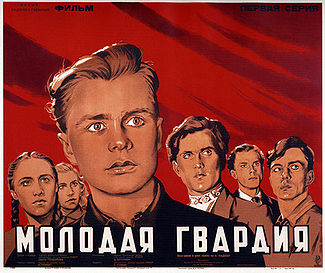
Source: Fair use, https://en.wikipedia.org/w/index.php?curid=2725128
\n
\n
\n
\n
\n
\n
\n
\n
\n
\n
\n
\n
\n
\n
\n
\n
The young guard was billed as a children’s film fallen idol
\n\n
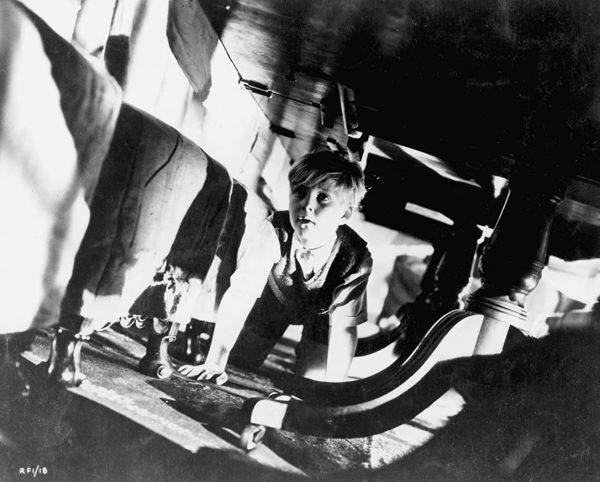
The horrified kid, the only eye-witness of a murder in The Fallen Idol
\n
May 1946 post-Japanese occupation recovery: The Young Plan 楊慕琦計劃 was a constitutional reform proposal carried out in 1946 attempting to introduce representative democracy in Colonial Hong Kong. Named after the then Governor, Mark Young, it was the first major reform proposal to give Hong Kong inhabitants a greater share of managing their own affairs by widening the base of Hong Kong’s political system through the creation of a new Municipal Council. The proposed Council was to consist of an elected majority based on a fairly wide franchise, with powers and autonomy over all urban services, education, social welfare, town planning and other functions. It even allowed for indirect election of two Unofficial Members of the Legislative Council (LegCo) by the new Council. Unofficial Members of the Legislative Council were opposed to the transfer of power to the new body and Young’s successor, Governor Alexander Grantham who was opposed to the Young Plan, did not press this issue. Discussion dragged on but the continued opposition of Unofficials in LegCo in addition to the fear of the potential of penetration by Communist China finally killed the plan in 1952. This was the last move towards any form of major electorally-based government until in the 1980s during the Sino-British negotiations on Hong Kong’s sovereignty. … By the Young Plan, the Colonial Government meant to create a sense of belonging and loyalty to Hong Kong among all its inhabitants regardless of race in the shadow of increasing Chinese influence over the local population and also China’s demand for the return of Hong Kong.
\n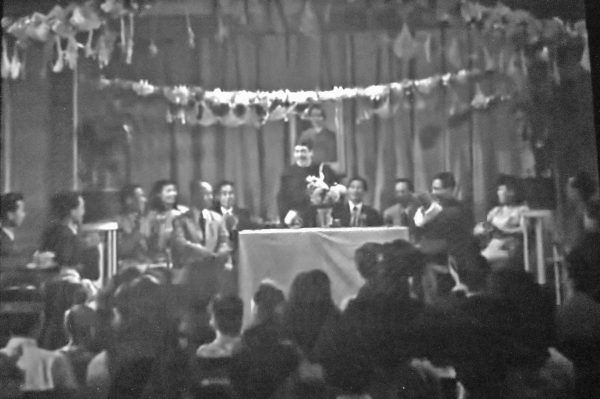
31,32,334,363.224121
No doubt The Kid still grabs the contemporary audience as it is on record the late kung-fu master Bruce Lee’s first screen appearance as a feature-length protagonist when he was just nine. [2]
\n‘The same piece of iron and steel could be turned into war weapons that destroy the world, or productive machines that benefit human kind.’ This morally charged dictum is not about corporate ethics, but about children, also the quote that opens The Kid (aka My Son A-Chang 細路祥, FUNG Fung, 1950) in which 9-year-old Bruce Lee plays a kid who spends his days on the street.
\nComics-artist Yuen Bo-wan’s five hand-drawn caricatures of the kid A-Chang (Bruce Lee) run through the opening sequence. With three bunches of hair on his head, A-Chang is unmistakably an emulation to Shanghai’s Three Hairs. As the credit sequence closes, A-Chang evolves from a cute naughty kid into a little gangster wearing a hat, with a knife in his right hand and his left leg kicking.
\n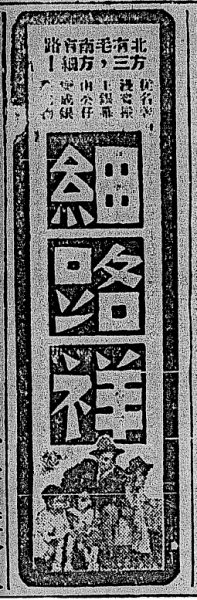
The Kid announced on 28 May 1950: graphics at bottom showing Uncle, A-Chang and his cousins
The film highlights two “primal scenes” where A-Chang’s struggle originates – the tenement buildings, “a multi-family dwelling occupied by the poor,” and street-hawking stalls [daipaidong]. [4] Orphan A-Chang lives in a tiny backroom of a tenement building with Uncle and his two kids. During the day, A-Chang runs an outdoor “reading gala” in a street corner. Hanging comic books on a few lines nailed to the wall, he charges a meagre rental fees to children who come to read. Nearby A-Chang’s stall is a bigger daipaidong, a street-stall on wheels serving noodles in soup, where members of a clandestine group often gather. Between the tenement room and the street-stalls, A-Chang is split between staying dependent and taking risk to go independent: should he go to school as Uncle wishes to become somebody in future, or should he join the labor force to make Uncle’s ends meet now? A-Chang quits school where rich kids bully him to work in a factory as cheap labor. Not accepting more bullying, he turns to a precarious street life to make quick money. He wants to be “man” as soon as possible. Trouble arises as he gets caught up in a gang’s plan to rob the factory where he has made true friends with the female workers.
\nThe central story – a kid’s encounter with the gangsters – is nested within a bigger story of the exploitative, hypocritical capitalists. A morally charged dictum screams before the first scene: “the same piece of iron and steel could be turned into war weapons that destroy the world, or productive machines that benefit human kind.” Then we see a fake philanthropist boasting his cash donation a free school to support street kids. The irony is blatant: his life-style, shown in the rest of the film, yields no productive machines.
\nThe Kid is full of progressive sentiments critiquing capitalist economy. The factory is a place of exploitation of women and children. Sexual harassment is a daily fact; children are subject to danger and abuse. Kids of the rich and the poor are forced to segregate. The film’s two true heroes are both female – the leader of the factory workers and the young daughter of the fake philanthropist, also a loyal friend of A-Chang’s. Though gangsters in shady business, they are also the protector of those the law cannot protect. These gangsters are as marginalized as children and women workers. The plot presents them to have no choice but live off the conspiracies of the rich’s own members. In ordinary conversations, they are individuals with convictions and a sense of righteousness.
\n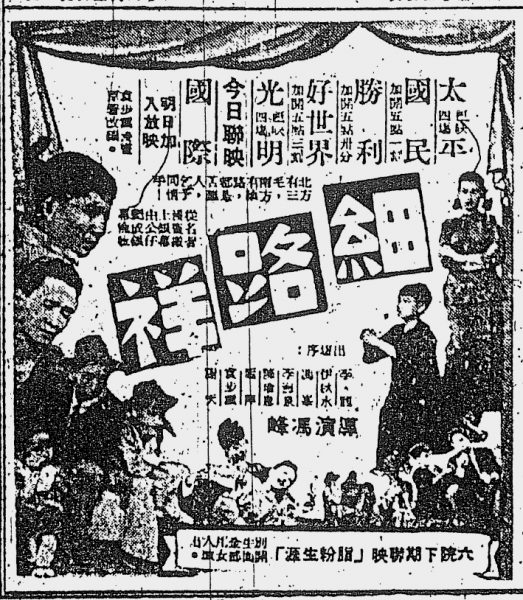
Newspaper ad on The Kid’s premiere, 31 May 1950, for 6 cinemas.
The film ends on a pastoral note. Uncle resolves to take A-Chang and his two little cousins back to the peace and purity of the countryside in China. To preserve the child, leaving the polluted colony is the only solution. A-Chang’s fall is about a boy who wants to be a man too early. Precociousness is dangerous. As the film closes, A-Chang bids his little girlfriend farewell, noting, “I don’t’ think I would come back anymore.” What would become of the kids? That remains an open question, to which the film offers little hope as the family walks away from the camera on foot on the rugged rail-tracks into the infinite depth of China.
\nNewspaper ads in 1950 find the film entangled in tough competition when it was first released on May 31 of the year. The first “coming soon” ads appeared in a few major Chinese-language newspapers on May 28, three days before the film was premiered in six movie theaters. The last ads were read on June 3, when the film was said to be shown in day-time slots only “due to contract arrangements.” One imagines the film’s marketing personnel burdened with alleviating box office threat from three competing films. Released on the eve of the International Children’s Festival (June 1), The Kid highlighted not only its focus on children, but also its turning a story originally in comics into live actions. From overseas, the main competitor was A Common Soldier (which should be The Young Guard, 1948, according to my research), a battle film from the Soviet Union’s Children Film Studio, dubbed in Mandarin, and billed as Cathay Theatre’s special presentation “for all children in Hong Kong and Kowloon” to celebrate the festival. Contents of the Soviet film’s ads uphold an exemplary model for dutiful sacrifice for one’s nation. The second competitor was The Fallen Idol (1948, dir. Carol Reed) by London Film Productions and British Lion Film Corporation. Scripted by Graham Greene based on his own “The Basement Room,” the film highlights its “talented child actor” Bobby Henrey. The selling point of the third competitor, Shanghai production The Winter of Three Hairs [San Mao Liulang Ji, aka An Orphan on the Streets] (1949, dir. YAN Gong, ZHOU Ming), was the film’s preserving the comics/cartoon style in its movie adaptation. “Funnier than comics – minimum dialogues, maximal actions,” its ads screamed. As for The Kid, newspaper ads openly state, “In the north there is Three Hairs, in the south there is the Kid,” equating Hong Kong (south) to Shanghai (north). How did the makers of The Kid differentiate the film from its competitors? The Kid does not laud any easy solution for national ills, unlike the call for individual commitment by national subjects in A Common Soldier. It makes no attempt to create a world of lies and deception as it would be perceived through a child’s eyes (Fallen Idols). Though both based on well-known comics, The Kid deploys no physical comedy of performative humor as in Three Hairs. The Kid is a heavy social realist drama duly softened by the fresh performance of a few kids including Bruce Lee. It anticipates Zhonglian’s social realism of literary proclivity in the 43 films produced in 1953-1964. [3]
\nYuen Bo-wan – after Japanese occupation, 在《成報》寫漫畫,這便是《細路祥》, 較有教育意義的連環圖. 10 cents per day rental / 3.5″ x 5″ size comic serials / a good boy turned bad and turned good again
\n\n
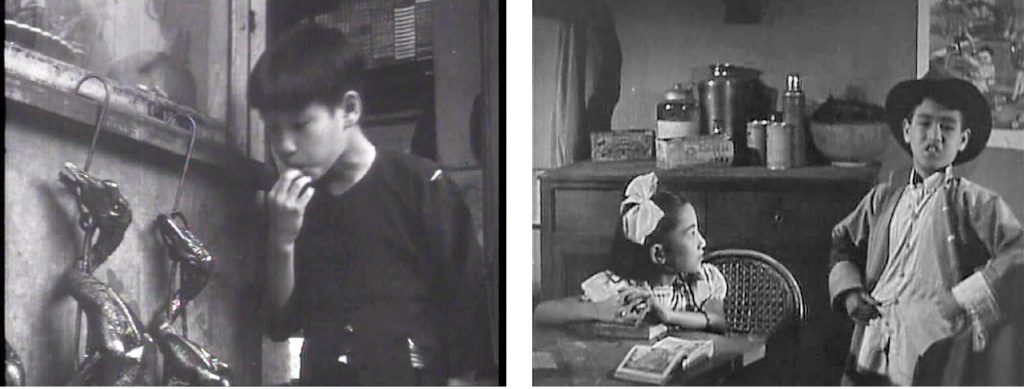
(Left) The starving A-Chang is tempted to steal the BBQ duck and run | (Right) A-Chang dressed up like a “man”…
\n
(Linda Chiu-han Lai)
\n
The opening of The Kid (1950), a title card highlighting HK local comics artist Yuen Bo-wan (name on L) as original writer, and Chor Kei (name on R) as screenplay writer. The figure in centre is “the Kid” in the comic version personified by Bruce Lee in the movie version
Xi Lu Xiang 《細路祥》
\nThe Kid (aka My Son A-Chang [1]), 77 minutes, b/w
\nElephantine Film Company, Hong Kong, released May 31, 1950 大象公司發行
\nMy Son, A Chang is the title used in the DVD released.
Dir Feng Feng [Fung Fung] (1916-2000) Scr Zuo Ji [Tso Kea] (adapted from comic strip by Yuan Buyun [Yuen Bo-wan]) Cinematog Yuan Zengsan [Yuen Tsang-sam] Ed Meng Long [Man Lung] Exe Prod Liang Biao [Leung Biu] Prod Co Datong Film Company Act Li Long [Bruce Lee] (Kid Cheung), Tang Yuan [Tong Yuen] (Su Mei), Wang Guilin [Wong Kwai-lam] (A Niu), Feng Subo [Fung So-bo] (A Zhu), Yi Qiushui [Yee Chau-shui] (Uncle Ho), Li Haiquan [Lee Hoi-chuen] (Hung Pak-to), Feng Feng [Fung Fung] (Flash Knife Lee), Yuan Buyun [Yuen Bo-wan] (Boaster Chiu), Gao luquan [Go Lo-chuen] (Secretary Ko)
\n***All Chinese names are spelt according to the pin yin system with Cantonese spelling included in […] for reference.
\nWhy was Young Guard on a Hong Kong screen? What does that tell us with the British-HK government regulating English subtitles (???) and Cantonese films struggling to grow in response to popular demand as the context? The Southern Film Corporation (Hong Kong), a major pro-PRC left-wing distributor founded in 1947, distributed Russian films in addition to pro-CCP Chinese films. Young Guard was just one out of over a hundred Russian films distributed in Hong Kong from 1946-1965, all subject to British censorship and passed. The film is thus a token of PRC presence, as opposed to Fung Fung’s My Son, A-Chang.
\n“According to Shu Don-lok who worked for Southern Film from 1948 to 1965, the distribution of Soviet films in Hong Kong was facilitated by Zhou Enlai (Shu 2005: 19). From 1946 to 1953, the company distributed about one hundred Soviet films, including some revolutionary and propagandistic ones such as the Vasilyev brothers’ Chapaev and Mikhail Romm’s 148 Lenin in 1918 and Lenin in October (Shu 2005: 20, 23), more than half of which were released before the PRC was founded. In 1947 and 1948, fifty-four Soviet films were submitted for censorship, only Vsevolod Pudovkin’s Admiral Nakhimov was banned and two others were slightly cut (Shu 2005: 25). The data shows that censorship of the Soviet films was lenient at first.” (Yau, 147-148)
\n“A 1950 document titled “Terms of Reference for Film Censors” (File Number: HKRS 934-5-34) states that besides paying attention to a film’s influence on social ethics, criminal activities and religious power, film censors should pay particular attention to films that: (i) Reinforced a political adversary and induced strong political sentiment;” (Yau, 146-147)
\nAs China turned Leninist-Communist, the KMT and CCP increasing played out their frictions in Hong Kong, and within the film industry, despite the British-HK government’s long-standing caution to keep Hong Kong “free” from the two parties scramble for power. … While CCP-KMT civil war drove many to the colony, general hardship of post-War refugee life provoked a general sentiments against capitalist realities. The local market had to be self-sustaining as censorship soon started on the other side of the HK-Chinese border. “The Hong Kong edition of Ta Kung Pao (cited in Yu 2000: 25) reported on 13 February 1950 that fifty Hong Kong films, ten in Mandarin and forty in Cantonese, were banned in Guangdong because of their reactionary contents.” (Yau, 108) My Son, A-Chang marks a unique border — it is severe critique of capitalist class discrimination in the guise of nationalistic patriotic (for China) although the two do not necessarily related.
\n“Some three months later, the same newspaper (27 September 1946, cited in Yu 1998: 81) reported that the Legislative Council intended to adopt a quota system by which all the first and second-run cinemas had to allocate one-tenth of their show time for British films; offenders were subject to fines and imprisonment.” (Yau, 101) Source: When the Attorney General moved the “British Cinematograph Films Bill” at the Legislative Council on 10 April, he said, “The essence of the Bill to attain the first objective to ensure that by employment of a quota system for a quota period of 70 days it shall be incumbent on cinemas to which this Ordinance applies to show for at least 7 days British films of which one at least shall be 5,000 feet long.” The council passed the bill on 24 April 1947 (Hansard: LegCo Sittings 1947 Session: 106, 128), and it was abolished in 1971. … Nationalist Government continued with the implementation of its regulatory provisions for film that started before the war and banned Cantonese-speaking films again. This explains why of the 4 newly produced films out of 9 films (shown the year in 1946) they were all Mandarin-speaking films. The supply and production of Cantonese films gradually picked up its pace when “Joe Chiu … [brought] over the Cantonese films Grandview made in San Francisco during the Pacific War years.” (Yau, 103) Cantonese films gradually came back to local screens in 1947, with 72 out of 90 local productions, the rest in Mandarin. My Love Comes Too Late 《郎歸晚》, with shooting starting 17 December 1946, took just a month to finish, and was exhibited on 21 January 1947. (Yu, 1998: 90) In 1948-49, about 250 out of 300 local productions were Cantonese films.
\nWhile My Son, A-Chang is, after all, a moral tale that provides a paradigm of proper responses to post-war social hardship asking the question of “who am I and where I belong,” responding to the problems of a general milieu with highly specific, personalized narrative account, the general environment of the British colony barely cast a shadow in the plot.
\n“On 1 June 1950, a Chinese-language newspaper in Singapore, Nan Chiao Daily (Nan Chiau Jit Pao), reported that, according to a telex dated 22 May 1950 from United Press (UP), a US news agency, the movie companies in Hong Kong were under the control of the Communist Party [referring to the CPC] almost without exception. The [colonial] government asked for a halt to all communist propaganda; that was to say, the government would not let Hong Kong ‘go red’ [go communist] (cited in Yu 2000: 24).”
\n“On 27 April, the Legislative Council enacted the “Illegal Strikes and Lock-outs, 1949” (Hansard: LegCo Sittings 1949 Session: 152)” “On 25 May, the “Societies Bill, 1949” was passed into law (Hansard: LegCo Sittings 1949 Session: 178-9); Subsection 3 of Section 5 of it states” restrictions to society registration.
\n“On 17 August, the council passed the “Registration of Persons Bill, 1949”, which was “to provide for the registration of persons the issue of identity cards” (Hansard: LegCo Sittings 1949 Session: 236-7). Section 9 of it provided the Registration 115 Commissioner or any authorized police officer with the lawful power to arrest and detain any suspect, and to search his/her property (University of Hong Kong Libraries). On 31 August, the council enacted the “Expulsion of Undesirable Ordinance, 1949” and the “Emergency Regulations (Amendment) (No. 2), 1949” (Hansard: LegCo Sittings 1949 Session: 240-3); the former was purported to be “[a]n Ordinance to control the population of the Colony by providing for the expulsion of undesirables therefrom as occasion may require” (University of Hong Kong Libraries), and the latter clarified: “(a) that the death penalty and other sanctions may be imposed; (b) that it has always been the law that such emergency regulations could over-ride the ordinary law” (Hansard: LegCo Sittings 1949 Session 1949: 234-5). Not long after the establishment of the PRC, the law-enforcement officials in Hong Kong exercised the power commissioned by the new ordinances mentioned above. On the fourth and fifth of January 1950, the colonial government expelled the chairman of the silk labour union and the principal of Heung To Middle School from Hong Kong respectively (Chau 2009: 95-6). On 31 January 1950, the government expelled three leaders of the tramway workers’ union after a more than one-month long strike which had led to a violent confrontation between the police and the workers on the night of 30 January 1950.106 From 4 January 1950 to 29 May 1959, a total of one hundred and eighteen persons were expelled without any court trial (Chau 2009: 365-7).” (Yau, 114-115)
\nI caution against inflating the meaning of a popular text (such as a movie) with social political background, a common explanatory model in film studies that I find problematic. There is a distinction to make between the interpretive activities of a film critic and the tracing of intricate relations between a cultural text and broad social cultural backdrop. I consider each film to be a unique cultural event; each such event shows a unique network of connectivity. My discussion is interested in how commercially driven bodies engage in message-charged cultural artefacts for their usage, imbuing commercial activities with political ideals and opportunism and, perhaps a personal response to an existential crisis in the guise of social ethics and moral beliefs … Text-context is still valuable if only we re-define what context means.
\nENDNOTES:
\n[1] My Son, A Chang is the title used in the DVD released.
\n[2] According to citations in the International Movie Database, Bruce Lee’s first (non-credited) screen appearance was in 1946, when he was six. According to Wikipedia, earlier in 1941, Lee appeared as an infant in Golden Gate Girl. 按國際電影資料庫所視,李小龍的首部沒有主要演員排名的電影演出為1946年,那時候他只有六歲。
\n[3] Full name of Zhonglian is Zhonglian Dianying, or Chung Luen (Union) Film Enterprise Limited.
\n[4] Linda C.H. Lai (2013), “The Kid on the Street: dai pai dong, tenement buildings, public housing,” Linda Lai and Kimburley Choi (eds.), World Film Location Hong Kong (Intellect Books, Bristol), 26-27. Tenement buildings, street hawkers’ stalls, and later on public housing, are crucial iconic locations in the history of Hong Kong films on which the drama of the lower class people is set.
\n\n
Useful Reference:
\n“Soviet Union,” History […], read 16 August 2020.
\n“The Young Guard (film),” Wikipedia. https://en.wikipedia.org/wiki/The_Young_Guard_(film)
\nChau, Yick (2009). 《香港左派鬥爭史》(literally The History of Leftist Struggle in Hong Kong), fourth Edition. 利訊出版社.
\nChen, Tina Mai 2009. “International Film Circuits and Global Imaginaries in the People’s Republic of China, 1949-1957”; Journal of Chinese Cinemas 3, no. 2. Pp. 149-152.
\nEndacott, G. B. (1978). Hong Kong Eclipse. Ed. and with additional material by Alan Birch. Oxford University Press.
\nFedorov, Alexandern 2020. Leaders of Soviet Film Distribution (1930-1991): Trends and Patterns
\nLoh, Christine 2010/2018. Underground Front: the Chinese Communist Party in Hong Kong (2nd edition).Hong Kong University Press.
\nShu, Don-lok (2005). 《墾光拓影 – 南方影業半世紀的道路》(literally Cultivate the Light, Expand the Shadow – The Half-Century Path of Southern Film Company). Hong Kong: Kubrick.
\nWelsh, Frank (1997). The History of Hong Kong (Revised and Updated Edition). HaperCollinsPublishers.
\nXu, Lanjun 2017. “The Southern Film Corporation, Opera Films, and the PRC’s Cultural Diplomacy in Cold War Asia, 1950s and 1960s”; Modern Chinese Literature and Culture, spring, v29, n1. Pp. 239-282.
\nYau, Lai-to Herman 2014. The Progression of Political Censorship: Hong Kong Cinema from Colonial Rule to Chinese-style Socialist Hegemony. PhD thesis, Lingnan University, Hong Kong.
\n