

Qatsi (2m27s), AI film, a tribute to Reggio's Qatsi Trilogy
[Qatsi | MIT AI Film Hack 2025] (Omi Bahuguna, Mark Chan, Yidi Zhou, Prisha Jain, Olivia Lee, NYU-ITP students)
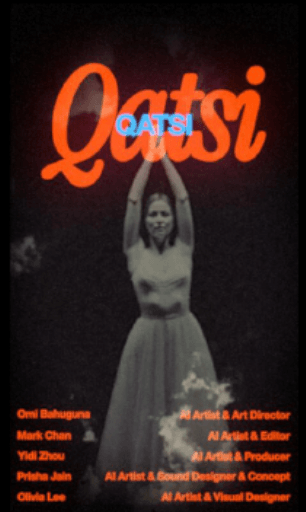
Qatsi, created in less than 48 hours for the 2025 MIT AI Film Hackathon, and uploaded 2 months ago, is an homage to Koyaanisqatsi (1982), the first of Reggio's “Qatsi” trilogy. On the level of visual content, Qatsi parallels the 1982 film's “visual exploration of motion as the axiom of life” — assembling images on the cosmos' vastness, nature's rhythm and the intimacy of human connection, from varied sources, including dance and movement. Salient similarities on the visual level is only the beginning in our understanding of the Qatsi (2025). The “flow of relationships, the inevitability of change, and the cycles of separation and reunion” are not limited to singular authorial intentionality; such existential theses are now subject to criterion-based data assemblage that speaks of potential continuity on a macro- and meta-narrative level. [note: I do not equate narrative with fiction story-telling as the term as been reductively use. I use the term “narrative” to describe procedural flows that construct and amount to additional meanings to the raw material. In this discussion, I use “narrative” to mean sight-and-sound discourses.]
What is AI film and why?
To call Qatsi a meta-narrative, that is, a narrative or image flow that is about existing narrative modes, is to seek connection of this work to the growing corpus of cinema. But AI media generation in video points to specific notions of creative freedom and creative resources to be tapped. The entire history of image-making, as long as it is made available on-line, forms the resource pool for a ready creator. As the MIT AI Film Hack team says,
“We believe creative AI will revolutionize storytelling, and our mission is to bring this power to everyone - so anyone can tell their stories.”
Qatsi and other films in the series are the result of makers hacking together and commbing different AI tools, including Autodesk’s Wonder Dynamics and Project Frames, Deemos' Hyper3DAI, HailuoAI, MeshyAI, and Molypix. The tools used in Qatsi include OpenArt, PixVerse, Midjourney, RunwayML and Flora.
Qatsi is one of the works resulting from MIT Media Lab's collaboration with filmmakers to explore AI technologies, to incite a new movement in the making. So, what new potentials does it demonstrate?
According to a survey essay on recent advances in GenAI for film creation, Qatsi is cited as an example of how “visual imperfections in AI outputs — blurred edges, odd proportions, inconsistent lighting — can be repurposed as aesthetic features.” traditional post-production techniques remain
essential for polishing AI-generated visuals. Nonetheless, Qatsi deploys regular post-production steps whereby AI-generated abstract imagery is inteegrated with film grain and color grading, “grounding its ethereal montages in the tactile texture of early cinema.”
The preparation of a “library” for a system, or the operable “data” that forms the base, before computing begins, are now automated through machine learning and web mining. It seems the mega resource pool is infinite, and yet the question of internal generative reproduction data trained on often black-boxed criteria make us question the appearance of infinite resources.