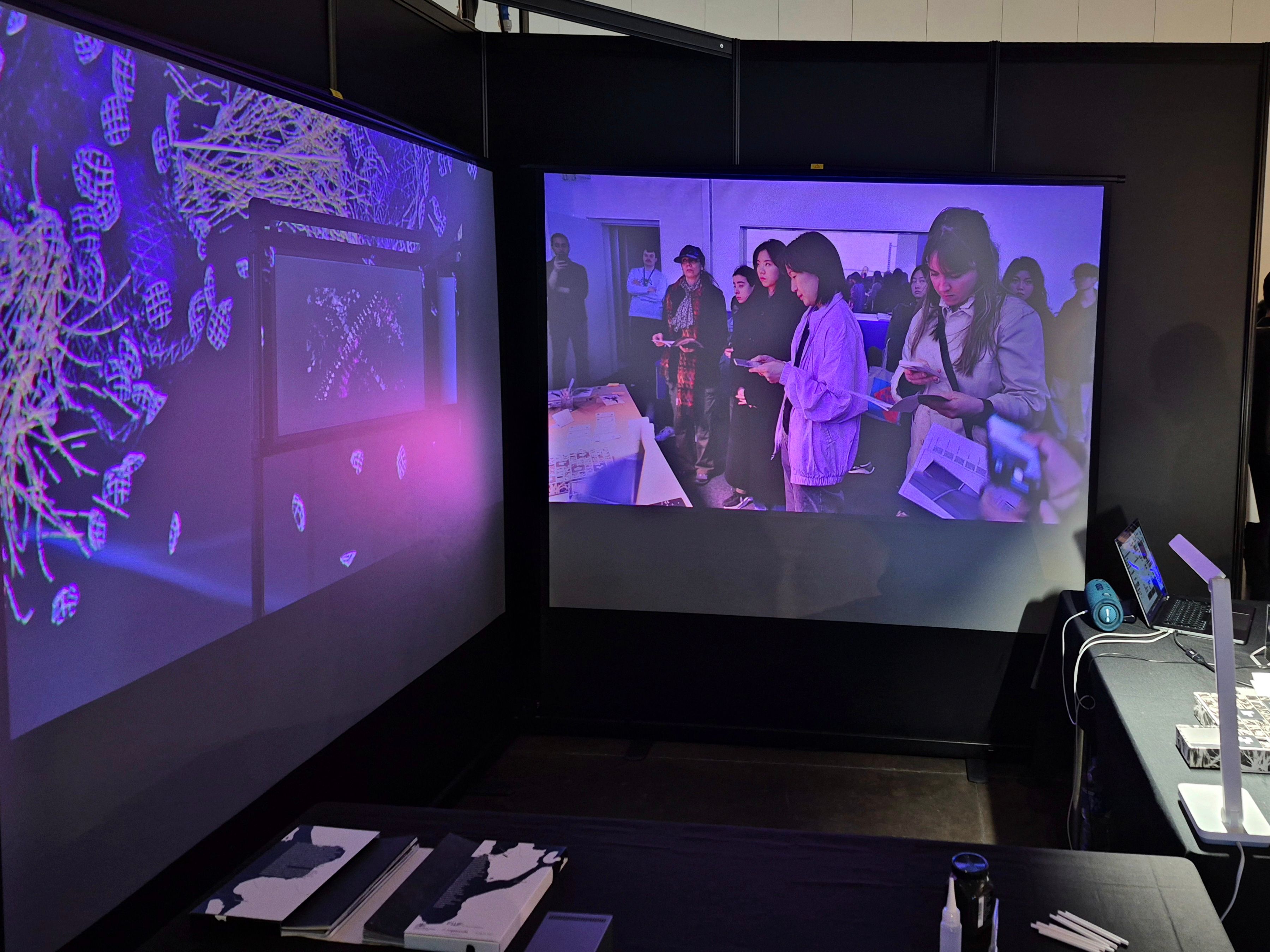
I visited SIGGRAPH ASIA on its second last day to catch "Weather spores" (WS, which is part of a larger program “ReWilding AI”) by an RCA team of artist-researchers I first met in March 2024 in "Ana-Cartography II / Real World Narratives" at Floating Projects (FP).
This time, Tom Simmons represented the team with a 2-screen documentation of an “Immersive point cloud installation” which, in its full form, goes with AR/digital performance components. WS disrupts the regular narrative frame (which often honours smooth flow and coherence of a single medium); its “narrative” strategy is to constantly shapeshift across knowledge systems and new materials, resting on a logic of cross-disciplinary associative connectivity deploying transmedia procedures. The door-knob, as I put it, that opens the door to the immersive AI narrative world is a dice, an object displayed on-site in the front table. As one "throws the dice" (or turn the door knob) to enter, one encounters the video walk-through of a forest or a bundle of mushrooms before they transfigure into data-visualizing digital marks, and non-representational automatic writings.
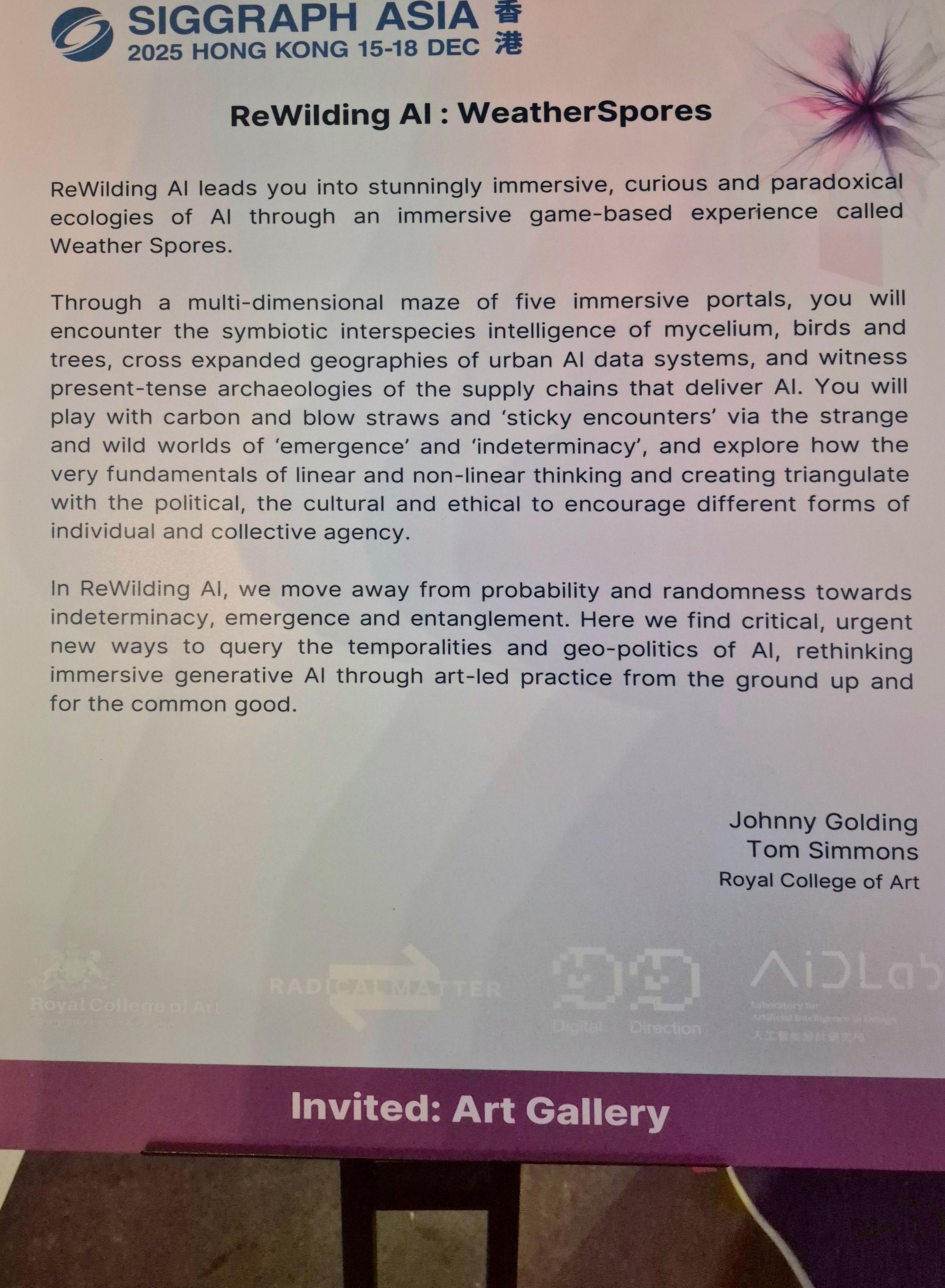
Manu Luksch sent me notes on Capital pAIns (Cp), her part in WS: Cp is a sound-led AR that conducts an audio-driven, present-tense archaeology of the supply chains that deliver AI – from mineral extraction, nanoscale manufacturing and e-waste, through algorithm design, data harvesting and cleaning by ghost-workers, to deployment and resistance in society."
WS is a multi-faceted work with components ranging from field work, data visualization, spatial localization, writing and unsupervised machine learning. I asked Tom about the main points of attention for visitors. Tom responded that the entire project of WS should best be experienced as a workshop series with actual participation. This to me holds an implicit critique, at least as I take it, on our fussy experience in a digital art show, especially with data-driven works. Heavily researched proceduralism, the core of digital “art,” is often hidden to give way to visual spectacles.
Surely there is a more affirmative view on this: data-driven art is often about gaming, playfulness and magic.
From a media-archaeological viewpoint, the desires for visual spectacles and magic -- or hidden passages that produce surprise with a supernatural touch – had been crucial driving forces for the evolvement of leisure and pleasure-related technologies. And now, in the current phase of an AI milieu, such desires to “override” limits spill over to encompass those of all knowing, not only omniscience or but also omni-presence.
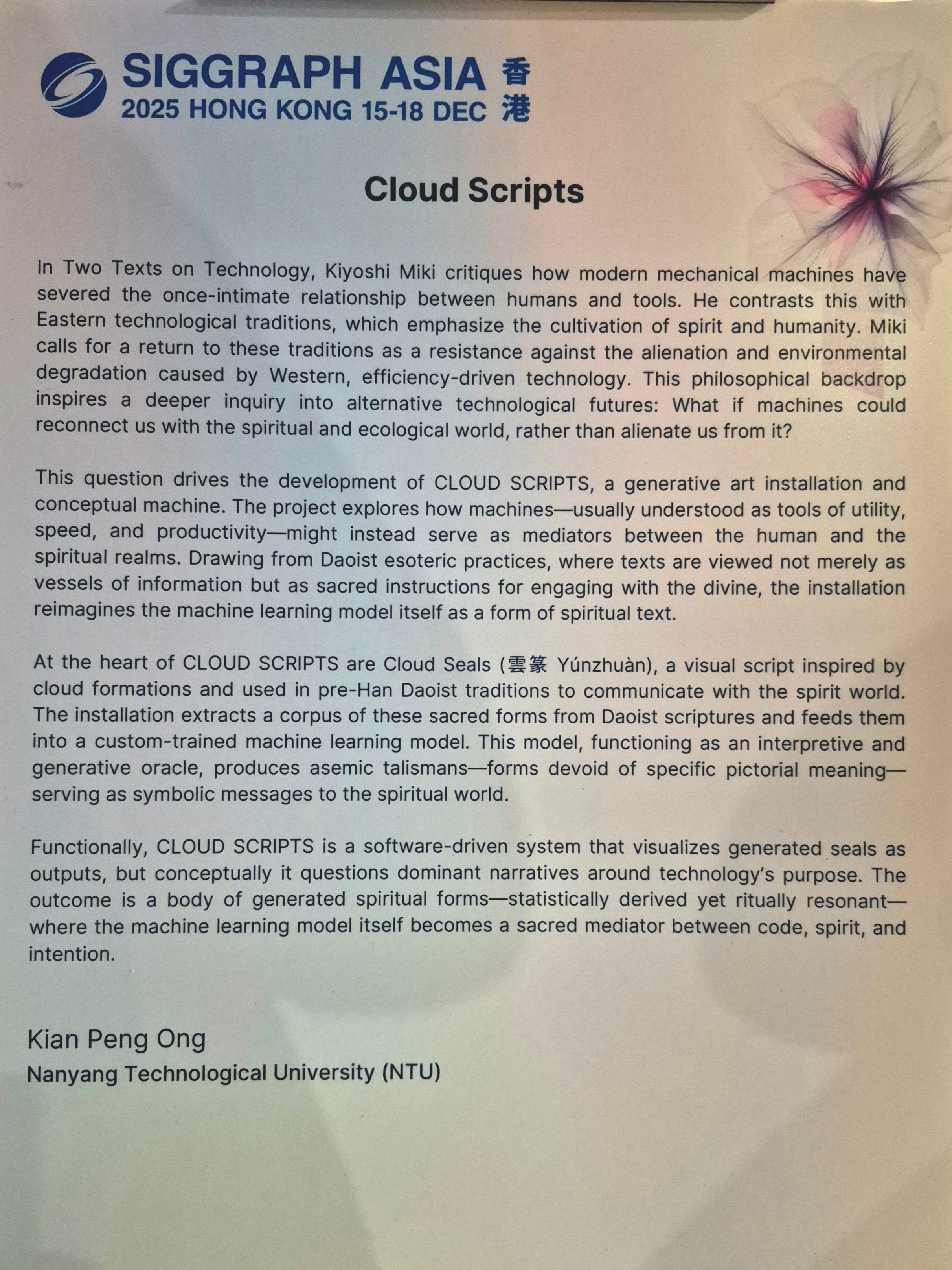
I gather that, as Tom implied, Weather Spores is not an easy work to exhibit in a trade-show environment. As a curious visitor, I benefit from talking to Tom. I also enjoyed my conversation with Kien Peng Ong, the artist for Cloud Script, on his deployment of existing satellite systems on global positioning. I enjoyed the process of sorting out how to interact with A Dialogue with the Sand by Keio University’s Junichi Yamaoka, digging into the voice (speech) -text (transformation) - (sand)writing procedures. I definitely found myself grasping more of the AI trends more efficiently with the posters on display (note: these are proposals not presented in the conference sessions) as they provide technical, procedural, diagrammatic and humanistic accounts in a nutshell, offering a lot of space for curiosity and probable imagination.