
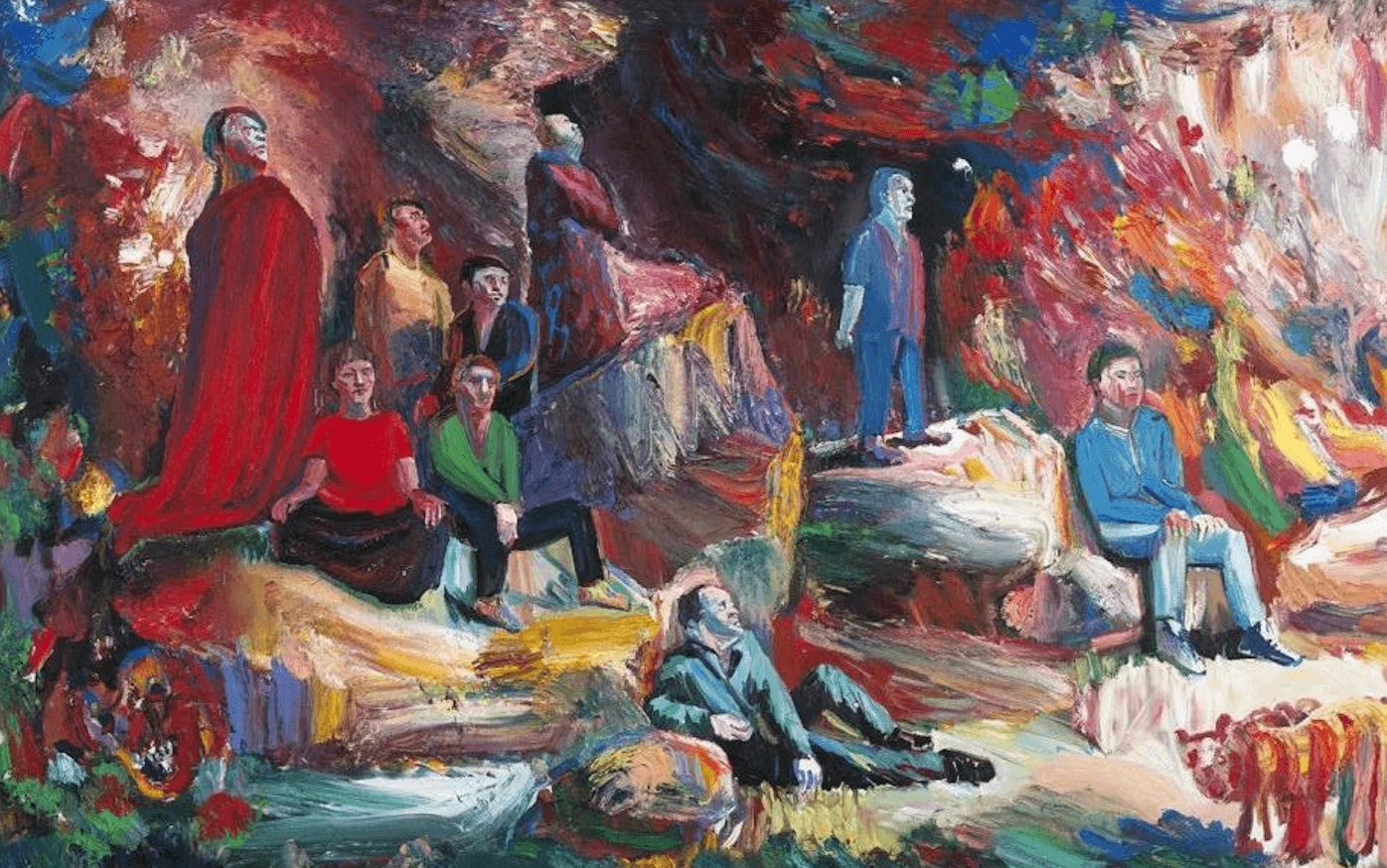
The first of the “Look At That Picture” series features graduate researcher ZHANG Lei’s close study of a painting by Chinese painter Yin Chaoyang (b. 1970), with an archaeological perspective.
**feature image: The painting “Vast History – Extreme Day” by Yin Chaoyang (Source: google.com)
Vast History – Extreme Day: A Metaphorical Work about the Human Condition and Destiny
“Vast History – Extreme Day” is an oil painting, 300x1100cm, created in 2020 by Yin Chaoyang, a Chinese post-1970s painter. I first saw the painting in February 2021 at an exhibition of his works in Shanghai.
As a huge work, the richness of “Vast History – Extreme Day” is striking. Applying different analytical frames to observe the work’s composition, then his work as a painter and his works’ social influence, I finally arrive in the painting’s metaphorical contemplation on the human condition and destiny, delving into its psychological richness, as well as the tension embedded in the tumultuous world presented in the painting.
Narrative frame: the fusion of light circle and people
“Vast History – Extreme Day” depicts hope for the future embodied in extreme light. The painting consists of three parts. In the center of the painting, there is a large, bright circle of light. On either side of the image, there are crowds of people. These people are looking into the distance, perhaps looking at the circle of light in the middle, perhaps looking at the crowd on the opposite side, or perhaps dazed or pondering in their aimless gazing. If you look closely at the figures in the painting, you will find that they have different expressions on their faces, some showing fright and confusion, while others are thinking and praying.
The characters in the paintings are all ordinary individuals in the true world, who has a very different life. When these fragmented lives are aggregated in one painting, it conveys the whole process of human entropy enhancement. A circle of light in the center of the painting gathers the content of the entropy increase. Focusing on the details of this painting, it is easy to find that the original circle of light in the middle is composed of hidden human figures, and the extreme light comes from the crowd, echoing the crowd with different expressions outside the circle of light.
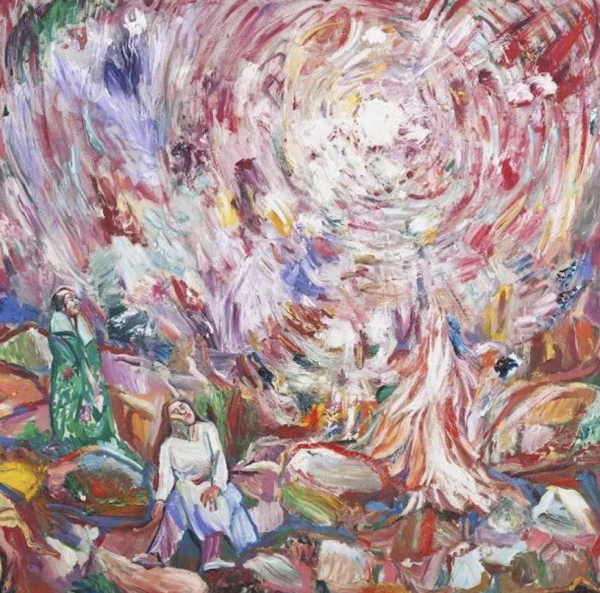
The circle of light in “Vast History – Extreme Day” (Source: google.com)
Composition Frame: conveying a hopeful mood
Analyzing from the perspective of composition, it can be found that “Vast History – Extreme Day” adopts a golden triangle composition. The image consists of three parts, the layout of the figures on both sides shows a triangular shape, and the light circle in the middle and the figures at the bottom also form a triangular shape. This composition gives a sense of stability to the extremely dizzying image, which contrasts with the content of the image “Vast History – Extreme Day”.
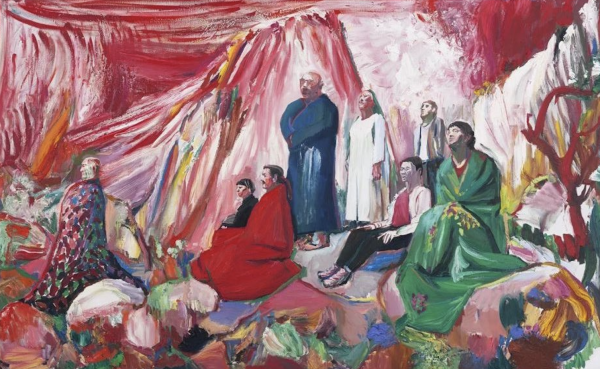
A golden triangle composition in “Vast History – Extreme Day” (Source: google.com)
In terms of color, the entire painting is in warm colors, conveying a strong and hopeful mood. Although the real life under the extreme day is full of difficulties, the artist gives people hope through color and leaves ample imagination space for the viewer in the text. In “Vast History – Extreme Day”, the viewer will get a different meaning of the text when looking at the characters of a situation alone than when the characters are placed in the whole work. When looking at a few of the characters alone, one can see the sad expressions on their faces. However, if these characters are placed in the whole work, one can see the circle of light from which these characters look into the distance, painful but full of hope.
Painter Frame: showing the memory of the times
The artist of “Vast History – Extreme Day” is Yin Chaoyang, a Chinese post-70s painter. Yin Chaoyang specializes in landscapes and the presentation of internalized psychological works. He spent more than a year to conceptualize the work “Vast History – Extreme Day”, and finally completed the whole painting in three months.
Analyzed from the artist’s point of view, it can be found that this work is a painting for himself, a short summary of his past time, and opens a new era of personal creation. In “Vast History – Extreme Day”, the painter blends the past into the background, and the colorful background conveys the bitterness and happiness of the past life. The people coming out of the past have different expressions, representing the marks of different times. But all these traces eventually converge in the circle of light, leading to the future.
The “Vast History – Extreme Day” is clearly marked by the times, expressing a certain kind of human desire and description of the ultimate problem. Through the dress code, we can see that the characters in the work may come from different nationalities and classes, and they are looking into the distance and thinking about life. From another dimension, it can also be argued that these characters may come from different times. When the painter brings together figures from different eras in the same work, it shows the same issue that people in different eras are concerned about, namely the ultimate question of human beings.
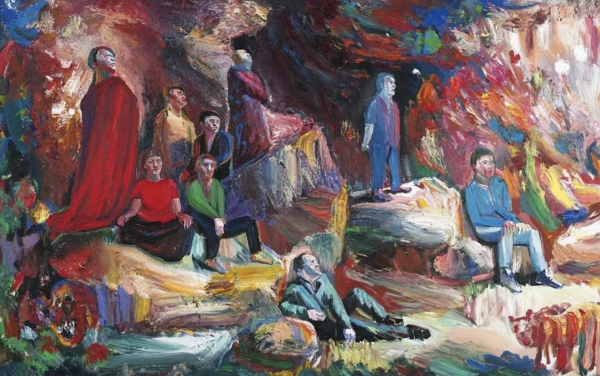
The group of people in “Vast History – Extreme Day” (Source: google.com)
In an interview, painter Yin Chaoyang said, “What I hope to express through this painting is a psychological state, conveying an emotion and tension (Wang Jiaji, 2021).” “I hope that in a few years later, when others see this work, they will understand that it is a product of this era. I think a great painting must be able to reflect the temperament of that era to the fullest (Wang Jiaji, 2021).”
Society Frame: the painter, the work, and the viewer construct meaning jointly
From the social framework, it is easy to find that this painting expresses a deeper meaning. In the painting “Vast History – Extreme Day”, the group of people on the outside is very clear, but the group becomes more blurred to the middle. Similar to the composition of society, in the complex social network, the more people in the higher class have more identities, the more they are unable to extricate themselves, similar to the blurred figures in the circle of light in the image. The more people in the lower class, the more people at the edge of society, the more single identity, the more distinct personality, similar to the people at the edge of the image. The individuals at the edge, participating in social relations as spectators, look up to the higher society, similar to the crowd around them in the image looking up to the circle of the light. These people look up to the circle of light in different positions, not knowing that the people in the circle of light with ambiguous identities are also envying them, just like a walled city.
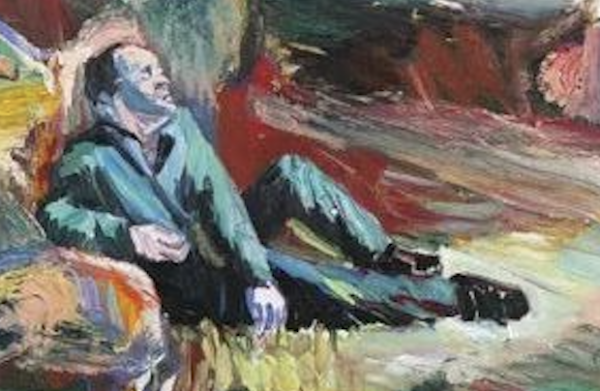
A man with a suit in “Vast History – Extreme Day” (Source: google.com)
“Vast History – Extreme Day” uses rich colors to show the fantasy and movement of the vortex, demonstrating the complexity of life and the bittersweet state. This is the self-characterization and self-description of the post-70s painter Yin Chaoyang and the painters of this generation. Due to the unique historical reasons and background in China, this generation has contradictory and painful emotions within them in the consumer society and post-ideological reality. Human emotions are a product of biological development, social development, and historical development. These inner emotions come to a great extent from the unique social context where they live. When these emotions are reflected on the image, the viewer interacts with the painter through the work, resonating and finding the meaning of the text in its cultural and historical context. The emotions conveyed by the painter are reminiscent of the “Purgatorio” in Dante’s Divine Comedy, leaving ample space for the viewer to interact.
Zhu Zhu (2011, p23) suggests that Art creation is a process of objectifying the painter’s emotions. Yin Chaoyang processes and transforms material materials according to a certain emotional logic, which has the effect of awakening and activating the hearts of others. Through this work, Yin Chaoyang evokes the collective memories of the post-70s generation. The painter and the work refer to each other, and the work interacts with the viewer. So the meaning of “Vast History – Extreme Day” is created among the painter, the work, and the viewer. “Vast History – Extreme Day” transforms the painter Yin Chaoyang’s private emotions into social emotions, evokes the collective memory of a generation with private memories through the exhibition.
REFERENCES
Wang, Jiaji. (2021). Aspiration and state of mind – Yin Chaoyang’s self-narrative. Rongbaozhai: Contemporary Art Edition, (5), 210-219.
Wen F. (2008). Yin Zhaoyang New Rising Test. New Fortune, (12), 128-129.
Yi Ying. (2002). Ideals and anxieties – On the art of Yin Chaoyang. Modern Art, (1), 65-67.
Zheng W. (2016). Yin Chaoyang: Opening the door. Art Contemporary, (3), 54-57.
Zhu Q. (2002). Cruel paintings of youth: A collective escape of youth. Art Contemporary, (5), 58-60.
Zhu Zhu. (2011). Gas to the floor: An interview with Yin Chaoyang. Art Contemporary, (6), 20-25.
浩瀚史 – 極晝:思考人類現狀及命運的隱喻性作品|張蕾
不得不承認,“浩瀚史-極晝”是一幅非常偉大的作品。它是一幅布面油畫,尺寸是300x1100cm。該作品創作於2020年,畫家是中國著名70後畫家尹朝陽。2021年2月,我在尹朝陽位於上海的畫展上第一次見到這幅作品。
作為巨幅作品,“浩瀚史-極晝”的豐富程度令人震撼。在作品、構圖、畫家與社會影響等不同的框架下,可以發現,這是一個關於人類處境與命運的隱喻之作。“浩瀚史-極晝”表達的是一種心理狀態,傳達出一種情緒和張力,在畫家、作品與觀眾之間產生了對這個紛繁的世界的全新解讀。提出對人類終極問題的渴望與描述。
敘述框架:光圈與人的融合
“浩瀚史-極晝”描繪了由極度光亮所導向的對未來的期盼。這幅畫由三部分構成。在畫面的中心,有一個巨大的非常亮的光圈。在畫面的兩側,分佈著人群。這些人看著遠方,可能在看中間的光圈,可能在看對面的人群,也可能在漫無目的的眺望中發呆或者思索。仔細看畫中的人物,會發現他們臉上的表情各異,有的表現出驚恐與困惑,有的則是在思考與祈禱。
畫中的人物都是生活中平凡的個體,每個人都有迥異的生活。當這些碎片式的人生聚合在一幅畫中時,傳達出整個人類墒增的過程。而墒增的內容全部彙聚在這幅畫中間的光圈裏。聚焦於這幅油畫的細節部分,會發現原本位於中間的光圈是由若隱若現的人影組成,極度的光亮來源於人群,與光圈外表情各異的人群形成呼應。
構圖框架:傳遞希望的情緒
從構圖的角度分析,可以發現“浩瀚史-極晝”採用了黃金三角型構圖。畫面由三個部分組成,兩側的人物佈局呈現出三角型,中間的光圈與底部的人物同樣構成一個三角型。這一構圖方式,讓極度眩暈的畫面給人一種穩定感,與畫面表達的內容“極晝”形成反差。
在色彩方面,整個畫作採用暖色系,傳達出強烈並充滿希望的情緒。雖然極晝下的現實生活充滿困境,但畫家通過色彩給人以希望,並在文本中給觀眾留下了充足的想像空間。在“浩瀚史-極晝”作品中,觀眾單看局面的人物,與把人物放在整個作品中將得到不同的文本意義。單獨看其中的幾個人物時,能發現人物臉上悲傷的表情。但放在整個作品中,又能體會到這些人物望向遠方的光圈,雖然痛苦但內心充滿著希望。
畫家框架:展現時代的記憶
“浩瀚史-極晝”的畫家是尹朝陽,他是一位中國的70後畫家。尹朝陽擅長山水風景及心理內化作品的呈現。“浩瀚史-極晝”這一作品,他用了一年多的時間來醞釀構思,最後在三個月內完成整個畫作。
從畫家的角度分析,可以發現這幅作品是畫家為自己而畫,是對過往時光的一次簡短總結,並開啟了個人創作的新時代。在“浩瀚史-極晝”中,畫家將過去的時光融合在背景裏,五彩斑斕的背景傳達出過去生活的苦與樂。從過去時光中走出來的人們表情各異,代表著不同的時代的印跡。但這些印跡最終都彙聚在光圈當中,通向未來。
“極晝”帶有明顯的時代烙印,表達了某種人類對終極問題的渴望和描述。通過著裝可以看出,作品中的人物可能來自於不同的民族與階級,他們望向遠方,思考著人生。從另一個維度也可以認為,這些人物可能來自於不同的時代。當畫家把不同時代的人物彙聚在同一幅作品中時,展現出不同時代人們關心的同一問題,即人類終極問題。
畫家尹朝陽在接受採訪時表示,“希望通過這幅畫表達的是一種心理狀態,傳達一種情緒和張力。”“我希望在若干年之後,當別人看到這件作品的時候,會理解這是一個帶有非常明顯的這個時代的產物。我覺得偉大的繪畫作品一定是把那個時代的氣質能夠體現的淋漓盡致。”
社會框架:畫家、作品、觀眾共同構建意義
從社會的框架下,可以看出這幅畫表達了更深刻的涵義。在“極晝”這幅畫中,處於外側的人群是非常清晰的,越靠近中間的部分,人群越來越模糊。與社會的構成類似,在複雜的社會關係網中,越處於高階層的人身份越多,越無法自拔,與畫面中光圈裏模糊的人影類似。越處於低階層的人,處於社會邊緣的人,身份越單一,個性越鮮明,與畫面邊緣的人群類似。處於邊緣的個體,以看客的身份參與到社會關係當中,他們仰望著高層社會,就像畫面中周圍的人群仰望光圈一樣。這些人以不同的姿勢仰望著光圈,殊不知光圈中身份模糊的人也在羡慕著他們,就像一個圍城。
“極晝”用豐富的色彩展現漩渦帶來奇幻與動感,展示出生活複雜,與苦樂交織的狀態。這是70後畫家尹朝陽與這一代的畫家的自我特徵與自我描述。由於中國獨特的歷史原因與背景,這一代人在消費社會和後意識形態現實中,他們的內心存在著矛盾與痛苦的情感。人的情感是生物發展和社會歷史發展的產物,這些內心的情感極大程度上來自於他們所處的獨特的社會背景。當這些情感反應在畫面上時,觀眾與畫家通過作品互動,產生共鳴,並在文化與歷史背景中尋找文本的意義。畫家所傳遞的情感使人聯想起但丁《神曲》中的“煉獄篇”,給觀眾留下了充足的互動空間。
朱朱認為,藝術創作是畫家情感客觀化的過程,尹朝陽按照一定的情感邏輯,加工改造物質材料,具有喚醒並啟動他人心靈的作用。通過這一作品,尹朝陽喚起了70後一代的集體回憶。畫家與作品相互參照,作品與觀眾進行互動,“極晝”這幅作品的意義在畫家、作品、觀眾三者之間產生。“極晝”將畫家尹朝陽的私人情感轉化為社會情感,通過展覽,用私人記憶喚起了一代人的集體記憶。