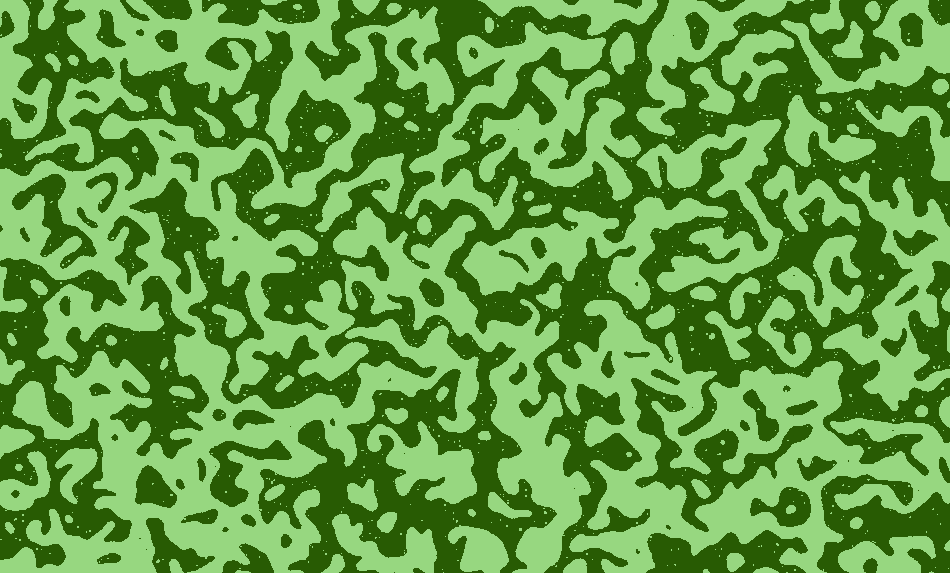
feature image: David Eppstein, CC0, via Wikimedia Commons: “The anneal (B4678/S35678) Life-like cellular automaton, 1600 generations after starting from a random initial state, shown at a scale of 4:1 (16 cells per pixel).” (3 November 2015)
work by Samuel Monnier: Low-resolution detail of an art work by Samuel Monnier. Inspired by the w:Fibonacci word fractal. Orginal owned by Alexis Monnerot-Dumaine.
Dear Linda,
Good evening. I found this interesting page on instagram (https://www.instagram.com/p/CYFJ63uolfa/?utm_source=ig_web_copy_link). The AI method of making experimental moving images reminded me of the lesson that talks about extending our senses with the optical unconscious. Since complete automatism is a myth, coding seems to be the ultimate solution to fill this loophole of human’s incapability. Will the films that try to make metaphors on human consciousness or explore the optical unconsciousness of humans be dominated by these generative arts? Because it seems like the traditional way like Stan Brakage’s film cannot carry out this kind of impact anymore. So, there came the structural films of Andy Warhol’s “Sleep” and Micheal Snow’s “Wavelength” . Are they trying to let us “see” our own consciousness by letting us wander, thinking around while watching their film? Instead of visually, metaphorically show what“consciousness” looks.
Best regards,
Yuen
////
Dear Yuen,
#1
I’m not sure full automatism is ever what we (humans) want or need. (But yes, perhaps drivers of progress are aiming at that without telling us exactly why and how.) We want to have a collaborative relationship with machines and technology — we and tools and machines (technics) are all actants (as opposed to human being active, the actor, and machines being passive, to be acted upon). There are moments, true, when we want the machines we made or the programs we wrote to “surprise” or “shock us” by taking up procedures in bulk volume and massive speed. That is computation and now a new magnitude and altitude with AI. Technologists have made machines to be able to learn on their own in order to “teach” us back something on the data level. The ever-evolving scenario also invites us to be ever sober in sustaining a dynamic relation with machines.
I need to add that there were at least two driving forces innovating art since the last century: building a network out of a single art object/event (work-in-progress, cybernetics…), and the desire to construct systems, or models that would generate an infinite number of works or compositions (serialism, parametric organization, artworks expressing generative thinking). … …
#2
Scientists, technologists and artists have very different truth methods. The way they explore the world, what kinds of comments they make about the world, and how they do/show it differ significantly, though without dialogues.
#3
I’m not sure if (full) automatism is a fair or sufficient context to understand Stan Brakhage, Andy Warhol and Michael Snow’s works. But I like what you said, that they were seeking ways to articulate other levels and aspects of our consciousness, and it turns out that one shared feature is they allow their mind and perceptions to “perform” and they do that by producing their own method of dealing with time. In my view,
Stan Brakhage’s works are more constructivist in a sense that he is reaching out to a liminal zone between knowing, feeling, sensing and describing, which is fluid and non-finite, allowing “not-knowing” to be a positive element or, a form of knowing. Truths of the world reside in between shots and their further disintegration.
Andy Warhol pushes cinematic time back to the phenomenology of seeing, which is a characteristic of Early Cinema, displacing comprehension by bringing back thick descriptions. Warhol poses his critique of a moving cinema practice that is integral of consumer culture by highlighting real time, and, to me, here also lies his method of negation. From negation comes the new.
Michael Snow believes in tools and machines’ ability to overcome the limitation of our haptic presence. Machine presence, then, is an extension of us.
I think (in class) I have not discussed them to be what we must follow suit but rather to point out the need to ask the question: what was it (traditions and conventions) that they were problematizing through their artistic creation, and what is it they we, here and now, are addressing.
#4
It remains a prominent question to address: in what way(s) is artworks produced by AI experimental? Is it the use of technology, and/or the pursuit of automatism, that defines contemporary experimentation in art? Are all instances of AI the same? What exactly is the relation between an artist and a work that deploys AI? (I suppose we can only talk about specific instances and not generality.) And AI is not one thing, we need to go to a lower level. These are different but connected questions.
Is the example you shared an artwork? It is, if the maker claims so, then s/he would have to clarify the piece for its integrity as art. Or it wouldn’t mind if we just think of it as a test for an event, a demo, a proto-type, or…
Good morning, Nok-hang. Thanks for sharing your thought.
Linda